


Engineering Data
1 /24Pages

Engineering Data
1 /24Pages
Catalog excerpts

■ Misalignment Fundamentals ■ U.S. Inch Clearance / Interference Fit StandardsKeyway Recommendations ■ ■ Lovejoy, Inc Metric Clearance / Interference Fit StandardsIEC Motor and Nema Motor Frame ■ Standards >
Open the catalog to page 1
Parallel MisalignmentFigure 1Angular MisalignmentFigure 2Axial MisalignmentFigure 3Composite Radial Misalignment Figure 4 Life Versus Misalignment Figure 5 > The function of a coupling is to connect driving and driven equipment. In addition, a coupling serves to protect costly equipment from the effects of misalignment, shock loads, vibration and shaft end float. Of these factors, the most common is misalignment and end float (also known as axial misalignment).Misalignment is a condition created by two shafts whose axes are not in the same straight line. There are three forms of misalignment:...
Open the catalog to page 4
When it is not possible to measure the misalignment of a system, or in designing a new system, the following method can be used to estimate angular, parallel and combined misalignment. Each type of misalignment is first calculated and then the results are combined.To calculate the maximum angular misalignment, the distance (L) and angle (a) must be known or estimated (see example below). First, calculate the angular misalignment noting the critical plane or midpoint of the shaft ends. Second, using the maximum parallel misalignment, be sure to consider both horizontal and vertical directions...
Open the catalog to page 5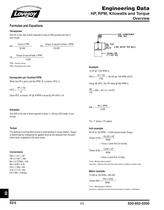
One HP is the rate of work required to raise 33,000 pounds one foot inone minute. Force x FPM Torque (in pound-inches) x RPMHP = חחחח HP = חחחחחחח-- 33,000 63,025 Torque (in pound-feet) x RPMHP = חחחחחחחח 5,252 > FPM = Feet per minuteRPM = Revolutions per minute 15 HP @ 1750 RPM is: 15 x 100HP/C = חח = .85 HP per 100 RPM (HP/C) 1750Using .85 HP/C, the HP rating @ 800 RPM is:.85ח x 800 = .85 x 8 = 6.8 HP100 Nm x RPMKW = חחחח 9,550TQ = F (force) x R (radius) > When the HP is given and the RPM, N, is known, HP/C is: HP x 100HP/C = חחח NOnce HP/C is known, HP @ N RPM is found by HP=HP/C x N > One...
Open the catalog to page 6
An overhung load is a bending force imposed on a shaft due to the torque transmitted by V-drives, chain drives and other power transmission devices, other than flexible couplings. Most motor and reducer manufacturers list the maximum values allowable for overhung loads. These values should be compared with the load actually imposed by the connected drive.Weights of the drive components are usually negligible. The formulas are based on the assumption that the load is applied at a point equal to one shaft diameter from the bearing face. Factor F, shown at right, depends on the type of drive used....
Open the catalog to page 7
HPSpeed(RPM)Torque > m ConstantזIncreases Decreases m > m ConstantזDecreases m Increases > m m Increases ConstantזIncreases Decreases m ConstantזDecreases m > m m Increases Increases ConstantזDecreases m Decreases m Constantז > Kva To FindAlternating CurrentTo FindAlternating or DirectCurrentSIngle PhaseThree PhaseAmperes when horsepower is known HP x 746E x Eff x pf HP x 7461.73 x E x Eff x pfAmperes when voltageand resistance are known E R Amperes whenkilowatts are known KW x 1,000E x pf KW x 1,0001.73 x E x pfVoltage when resistanceand current are knownIR Amperes whenKva are known Kva x 1,000E...
Open the catalog to page 8All Lovejoy catalogs and technical brochures
 Torsional
42 Pages
 HercuFlex Gear Couplings
28 Pages
 Lovejoy Hydraulics
24 Pages
 RunRight by Lovejoy Catalog
68 Pages
 HercuFlex Couplings Catalog
28 Pages
 QUICK FLEX® Couplings
56 Pages
 Grid catalog
19 Pages
 High Performance Gear Catalog
20 Pages
 Jaw
Jaw28 Pages
 4 BOLT DISC COUPLING
2 Pages
 Disc
Disc28 Pages
 Universal Joints Catalog
12 Pages
 Specialty Products Catalog
28 Pages
 Curved Jaw Couplings Catalog
22 Pages
 Stainless Steel Jaw Catalog
2 Pages
 Complete Lovejoy Catalog
522 Pages
 HydraulicReservoir
24 Pages
 LH COUPLINGS
2 Pages
 Motion Control Catalog
22 Pages
 Jaw In-Shear
8 Pages
 4 Bolt Disc Catalog
2 Pages
 Disc Catalog
28 Pages
 Jaw Type Catalog
28 Pages
 Lovejoy / Sier-Bath Gear Catalog
78 Pages
 FARR Gear Catalog
7 Pages
 Stainless Steel Jaw
2 Pages
 Torsional catalog
42 Pages
 Specialty catalog
28 Pages
 Universal Joint catalog
12 Pages
 BNZ Cooler Catalog
32 Pages
 Pump/Motor Mount Catalog
24 Pages
 Shaft Locking Devices catalog
24 Pages
 Motion Control Couplings
22 Pages
 Gear catalog
78 Pages
 Curved Jaw catalog
22 Pages
 Jaw In-Shear catalog
8 Pages
 L-LOC Clamp Feature
1 Page


Archived catalogs
 RunRight Products Catalog
68 Pages
 Jaw Coupling
28 Pages
 S-Flex
22 Pages
 Full Line Catalog
56 Pages
 S-Flex catalog
22 Pages
 FARR Rigid Couplings
6 Pages

- Fitting
- Hydraulic fitting
- Vessel
- Metal fitting
- Heat exchanger unit
- Shaft shaft coupling
- Industrial tank container
- Vertical tank
- Liquid/liquid heat exchanger
- Flange coupling
- Anti-vibration mount
- Tubular heat exchanger
- Torque coupling
- Rigid coupling
- Transmission coupling
- Zero-backlash shaft coupling
- Metal anti-vibration mount
- Sleeve coupling
- Compact coupling