
 Website:
Lin Engineering
Website:
Lin Engineering


Catalog excerpts
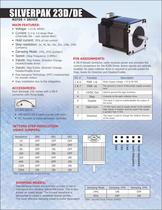
MOTOR + DRIVER SILVERPAK 23D/DE MAIN FEATURES: • Voltage: +15 to 48VDC • Current: 0.3 to 3.0 Amps Peak (Internally Set – user cannot alter) • Hold current: 25% of run current • Step resolution: 2x, 4x, 8x, 16x, 32x, 128x, 245x (jumpers) • Damping Mode: 14%, 35% (jumper) • Speed: (Step Frequency: 2.5MHz) • Inputs: Step Pulses, Direction Change, Disable/Enable driver • Inputs: Step Pulses, Direction Change, Disable/Enable driver • Pole Damping Technology (PDT) implemented for smooth motion • Easy installation due to the integration. Pin # Function Description 1 & 6 PWR +ve Motor Supply voltage. +15 to 48 VDC 2 & 7 PWR -ve The ground or return of the power supply connects here 3 +5VDC Out Used to ground the logic functions. 4 Step Connects to the open collector drive. 5 Disable This input is used to enable/disable the output of the driver. 6 Opto-Com +5 VDC input used to supply power to the isolated logic inputs. A resistor must be used if the supply is greater than 5 VDC. 7 Direction This input is used to change the rotation direction of the motor. PIN ASSIGNMENTS: p/n 090-00019 ACCESSORIES: Each Silverpak 23D comes with a DB-9 connector with flying leads. A DB-9 female connector cable receives power and provides the control connections for the R208 Driver. Active signals are optically isolated. An open-collector drive is required to provide pulses for Step, levels for Direction and Disable/Enable. Resolution SR0 SR1 SR2 2X OFF OFF OFF 4x ON OFF OFF 8X OFF ON OFF 16X ON ON OFF 32X OFF OFF ON 64X ON OFF ON 128X OFF ON ON 256X ON ON ON Table: Damping Mode Jumper Settings SETTING STEP RESOLUTION USING JUMPERS: • 090-00019 DB-9 cable (comes with unit) • PC, function or pulse generator, controller Damping Mode Damping 14% Damping 35% 14% ON OFF 35% OFF ON Table: Step Resolution Jumper Settings SR0 SR1 SR2 DAMPING 14% DAMPING 35% DAMPING MODES: Two damping modes are provided in order to aid in resonance and vibration within the motor. This is also known as mixed decay. The current waveform is dampened to create a smoother motion profile. The most effective damping mode is motor dependent.
Open the catalog to page 1
COMMON TECH SUPPORT QUESTIONS / RMA ISSUES: BURNED OR BLOWN DRIVER (LOW INDUCTANCE): Motors with inductance levels of 1.5 mH or less will cause the drivers to blow or not work as expected. Torque will drop because the output current is less than expected. (A limitation of the driver chip) MOTORS ARE HOT: Check holding current and running current. It could be too high. Check wiring. Motor phases could be crossed (A is in B or B Bar, etc) MOTORS DO NOT ROTATE: Check connection between motor and drive. If, for example, the “A” and “A Bar” connection is actually connected to an “A” phase wire...
Open the catalog to page 3All Lin Engineering catalogs and technical brochures
-
 SilverPak 17D Plus
1 Pages
-
 IP65 & IPX7 Vacuum Motors
1 Pages
-
 5818 ?Super Torque
1 Pages
-
 4518 ? Signature Series
1 Pages
-
 208 ? Standard Motor
1 Pages
-
 High Torque
1 Pages
-
 Why Lin 2014
2 Pages
-
 MICROSTEPPING DRIVER
2 Pages
-
 R208
R2083 Pages
-
 8718 HIGH TORQUE MOTOR
1 Pages
-
 8618 STANDARD MOTOR
1 Pages
-
 5718 HIGH TORQUE MOTOR
1 Pages
-
 5618 STANDARD MOTOR
1 Pages
-
 5609 STANDARD MOTOR
1 Pages
-
 5704 HIGH ACCURACY MOTOR
1 Pages
-
 4418 XTREME TORQUE MOTOR
1 Pages
-
 4118 SUPER TORQUE MOTOR
1 Pages
-
 4018 STANDARD MOTOR
1 Pages
-
 4209 HIGH TORQUE MOTOR
1 Pages
-
 4109 GOLD LINE MOTOR
1 Pages
-
 3518 STANDARD MOTOR
1 Pages
-
 3809 SERIES MODULAR MOTOR
1 Pages
-
 211 COMPACT MOTOR
1 Pages
-
 208 COMPACT MOTOR
1 Pages
-
 SilverPak 17C/CE
2 Pages
-
 SilverPak 23C
2 Pages
-
 GOLD LINE MOTOR
2 Pages
-
 MODULAR MOTOR 3609 SERIES
2 Pages
-
 1.8° SIZE 11
2 Pages
-
 STANDARD MOTOR
2 Pages
-
 SilverPak 17T
3 Pages
-
 1.8º SIZE 14
2 Pages
-
 HIGH TORQUE MOTOR 3509V
2 Pages
-
 Lin Catalog 2006
100 Pages


Archived catalogs
-
 SUPER TORQUE MOTOR 4118
2 Pages
-
 STANDARD MOTOR 5609
2 Pages
-
 STANDARD MOTOR 4018
2 Pages
-
 STANDARD MOTOR 8618
2 Pages
-
 SUPER TORQUE MOTOR 4118
2 Pages
-
 HIGH TORQUE MOTOR 4209
2 Pages
