

Explosion-proof roof fans — SPARK Ex
1 /6Pages

Explosion-proof roof fans — SPARK Ex
1 /6Pages
Catalog excerpts

42 SPARK Ex Explosion-proof roof fans Application SPARK/Ex explosionproof roof fans are constructed especially for application in spaces where explosive atmosphere, as a mixture of fl ammable substances in a form of gas, vapour and mist (with the air), can occur. They meet the requirements of ATEX 95(94/9/WE) Directive. Structure Bent steel profi les make up a frame structure of the fan. The motor along with a directly mounted radial brass impeller is of Ex execution. As protection against the atmospheric factors is a steel sheet hood with additives ensuring the discharge of the electrostatic loads. Fan housing is equipped with a clamp with cooper cable to lead the electrostatic charges away. The lower part of the fan is equipped with a steel fl ange as a mounting element to the roof base. Impeller of the whole SPARK/Ex series have been designed within the aspect of low noise. After testing of several impellers in the KLIMAWENT Research Development Laboratory optimal examples of the lowest noise level were fi nally selected. In order to reduce further the noise entering the room, it is recommended to install the fan on a sound absorbing roof base TPD or TPDC. As standard, the steel parts, i.e. supporting structure, openwork outlet and the mounting fl ange and the hood are powder painted in bright-grey colouring (RAL 7035). Caution 1. Maximum work temperature of the motor +40°C 2. Fans can be applied for conveying the dry air of maximum dustiness 0,3 g.m³ 3. Fans cannot be used for conveying the air containing viscous impurities, that would deposit on the structure elements, (especially on the impeller), neither including aggressive compounds, which could have destructive eff ect on the construction. II 2 G T3
Open the catalog to page 1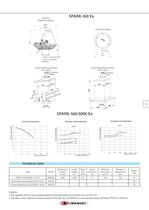
43 Type Part ¹ Synchronous rotations [1/min] Supply voltage [V] Motor rate [kW] Ingress protection [IP] Maximum volume fl ow [m³/h] Maximum underpressure [Pa] Weight [kg] SPARK- 160/3000/Ex II 2 GT3 808W60 3000 3×400 0,55 55 1400 760 22 Sound absorbing roof base TPD-160-N 843P40 - - - - - - 28 Sound absorbing roof base TPDC-160-N 843P50 - - - - - - 30 TECHNICAL DATA SPARK- Ex Sound absorbing roof base TPD-160-N Sound absorbing roof base TPDC-160-N 0 100 200 300 400 500 600 700 800 0 500 1000 1500 2000 2500 Static pressure [Pa] Flow characteristics Volume flow [m³/h] 40 45 50 55 60 65 70 75 80...
Open the catalog to page 2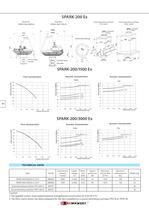
44 SPARK- Ex Type Part ¹ Synchronous rotations [1/min] Supply voltage [V] Motor rate [kW] Ingress protection [IP] Maximum volume fl ow [m³/h] Maximum underpressure [Pa] Weight [kg] SPARK-200/3000/Ex II 2 GT3 808W62 3000 3×400 0,55 55 1920 760 22 SPARK-200/1500/Ex II 2 GT3 808W63 1500 3×400 0,55 56 1870 740 53 Sound absorbing roof base TPD-200-N 843P41 - - - - - - 28 Sound absorbing roof base TPDC-200-N 843P51 - - - - - - 30 TECHNICAL DATA Sound absorbing roof base TPD-200-N Sound absorbing roof base TPDC-200-N 0 100 200 300 400 500 600 700 800 0 500 1000 1500 2000 2500 Static pressure [Pa] Flow...
Open the catalog to page 3
45 SPARK- Ex Sound absorbing roof base TPD-250-N Sound absorbing roof base TPDC-250-N 0 100 200 300 400 500 600 700 800 0 500 1000 1500 2000 2500 Static pressure [Pa] Flow characteristics Volume flow [m³/h] 40 45 50 55 60 65 70 75 80 85 0 500 1000 1500 2000 2500 3000 Noise level [dB(A)] Volume flow [m³/h] Acoustic characteristics from distance 1m 5m 10m 15m Outlet 30 35 40 45 50 55 60 65 70 0 500 1000 1500 2000 2500 3000 Noise level [dB(A)] Volume flow [m³/h] Acoustic characteristics Inlet from distance 1m 5m SPARK-/ Ex Type Part ¹ Synchronous rotations [1/min] Supply voltage [V] Motor rate [kW]...
Open the catalog to page 4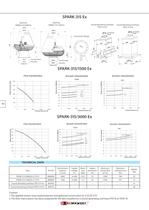
46 SPARK- Ex Sound absorbing roof base TPD-315-N Sound absorbing roof base TPDC-315-N 0 100 200 300 400 500 600 700 800 0 500 1000 1500 2000 2500 Static pressure [Pa] Flow characteristics Volume flow [m3/h] 40 45 50 55 60 65 70 75 80 85 0 500 1000 1500 2000 2500 3000 Noise level [dB(A)] Volume flow [m3/h] Acoustic characteristics from distance 1m 5m 10m 15m Outlet 30 35 40 45 50 55 60 65 70 0 500 1000 1500 2000 2500 3000 Noise level [dB(A)] Volume flow [m3/h] Acoustic characteristics Inlet from distance 1m 5m SPARK-/ Ex Type Part ¹ Synchronous rotations [1/min] Supply voltage [V] Motor rate [kW]...
Open the catalog to page 5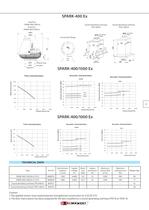
47 SPARK- Ex Sound absorbing roof base TPD-400-N Sound absorbing roof base TPDC-400-N 0 200 400 600 800 1000 1200 0 2000 4000 6000 8000 10000 Static pressure [Pa] Volume flow [m³/h] Flow characteristics 50 55 60 65 70 75 80 85 90 0 2000 4000 6000 8000 10000 Ciœnienie akustyczne dB(A) Volume flow [m³/h] Acoustic characteristics from distance 1m 5m 10m 15m Outlet 40 45 50 55 60 65 70 75 80 0 2000 4000 6000 8000 10000 Ciœnienie akustyczne dB(A) Volume flow [ m ³ / h] Acoustic characteristics Inlet from distance 1m 5m SPARK-/ Ex SPARK-/ Ex 0 100 200 300 400 500 600 0 1000 2000 3000 4000 5000 6000...
Open the catalog to page 6All KLIMAWENT catalogs and technical brochures
 PRODUCT Catalogue
298 Pages
 PODRYW-N
1 Page
 WW-302-KL
1 Page
 WOK-W
WOK-W2 Pages
 WOK-N
WOK-N2 Pages
 WPA-P-N
2 Pages
 fast-p
2 Pages
 WPA-14-S-N
2 Pages
 WPA-S-N
2 Pages
 WPA-E-N
2 Pages
 AIRCARE
2 Pages
 catalogue 2016
256 Pages
 Catalogue 2015
221 Pages
 SMOKING BOX
2 Pages
 Filtering unit — RAK-M
2 Pages
 Filtering unit — MATRIX 1000
2 Pages
 Filtering unit — UFO-N
2 Pages
 Roof fans — BULLET
2 Pages
 Extraction arms — ERGO/Ex
3 Pages
 Filtering unit UFO-4-M/N
4 Pages
 Extension arms — RO
4 Pages
 Roof Fans
13 Pages
 product catalogue
136 Pages
