
- Catalogs
- KLASCHKA Sensor & Motion Technologies
- Catalog ALSEN TK1

Catalog ALSEN TK1

Catalog ALSEN TK1
This document is a catalog section from Klaschka GmbH & Co. KG, focusing on inductive proximity switches and accessories. It provides detailed information on various types of sensors used in automation, including their specifications, applications, and connection diagrams.
The catalog categorizes inductive proximity switches by reference number and type. It includes detailed sections on tasks, mode of operation, requirement profiles, switching behavior, and mounting instructions. The switches are further divided into series based on their characteristics and applications, such as All Metal Standard, All Metal Automotive, and Ferro DC.
Accessories for sensors are listed with reference numbers and type designations. This includes connectors, adaptors, cordsets, and field attachable sockets and plugs. The document provides an overview of these accessories, highlighting their compatibility with different sensor types.
Sensors are described as physical-electrical converters that measure variables like distance, pressure, and temperature, converting them into electrical signals for controllers. The document outlines the internal configuration of sensors, emphasizing features like contactless detection, high resolution, and resistance to environmental influences.
Proximity sensors are non-contacting and are used in environments requiring high reliability and accuracy. The document distinguishes between acoustic, inductive, capacitive, optical, and magnetic field proximity sensors, each suited for different applications and environments.
The type code section explains the coding system used to identify sensor types, output and supply voltage, housing design, and other specifications. This helps in selecting the appropriate sensor for specific applications.
This catalog section serves as a comprehensive guide for selecting and understanding inductive proximity switches and their accessories, providing essential information for automation professionals.
The document outlines various specifications for sensors, including housing materials, type series properties, output configurations, connection types, and materials used for leads and housings. Housing materials include aluminum, stainless steel, plastic, mica, ceramic, brass, steel, and zinc. Type series properties cover a range of sensor types such as proximity switches, code readers, distance sensors, and safety switches.
The document describes the operation of inductive proximity switches, which consist of an oscillator, rectifier, and output amplifier. These switches detect metal objects by changes in the oscillator amplitude, which affects the switching condition of the output. The document also details the connection diagrams for DC 3- and 4-pole sensors.
The document references standards such as DIN 41 755 and EN 60947-5-2 for power supply and short-circuit protection. It specifies that sensors should operate within a voltage range of 10 V DC to 30 V DC, with a ripple not exceeding 15% of the supply voltage.
For power supplies, it is recommended to use filters and HF-capacitors to suppress transients and ensure stable voltage supply. The document also suggests considering the operating frequency and voltage fluctuations when selecting power supply units.
The document provides detailed information on materials used for sensor housings and leads, including metals like aluminum and stainless steel, technical ceramics, and various plastics such as ABS, epoxy resin, and polycarbonate. It also lists the specifications for PVC and PUR leads, including their cross-sections and outer diameters.
The document includes tables detailing the specifications of leads, such as the number of leads, cross-section sizes, and outer diameters. Connection diagrams for various sensor configurations are also provided, illustrating the wiring for plus-switching and minus-switching outputs.
This document provides detailed technical specifications and guidelines for the IAD/AHM series of inductive proximity switches, manufactured by Klaschka GmbH & Co. KG. These switches are designed for all-metal standard applications and are available in various models with different sensing distances and configurations.
- Operating Voltage: 10 to 30 V DC
- Current Consumption: ≤ 20 mA without load
- Load Current: ≤ 200 mA
- Nominal Insulation Voltage: 75 V DC
- Permissible Capacity at Output: ≤ 1.0 µF
- Protection Rating: IP 67 according to IEC 60529
- Protection Class: II
- Ambient Temperature Range: -25 to +85 °C
- Short-circuit-proof: Yes, clocking
- Reverse Polarity Protection: Yes
- Voltage Drop Over Closed Contact: ≤ 2.5 V DC
- Magnetic Field Resistance: ≤ 150 mT
- Hysteresis of Switching Point: 3 to 10%
- Repetition Accuracy: ≤ 10%
- Material: PBT / stainless steel or CuZn nickel-plated
- Sensing Face Diameter: Varies by model
- Switching Frequency: 15 to 20 kHz
- Wiring: Available with M8 or M12 connectors, 3 or 4 wires
- Connection, commissioning, and maintenance should be performed by specialists or instructed staff.
- Proximity switches comply with DIN EN 60947-5-2 standards.
- Standard lead lengths are 2 m, with options for 3 m and 5 m.
The products are certified according to DIN EN ISO 9001.
This document provides technical specifications and guidelines for the use of inductive proximity switches, specifically the Ferrous DC 3- and 4-pole series by Klaschka GmbH & Co. KG. These switches are designed for detecting ferrous metals and are standardized according to EN 60947-5-2.
- Operating Voltage: 10 to 30 V DC
- Current Consumption: ≤ 13 mA without load
- Load Current: ≤ 200 mA
- Nominal Insulation Voltage: 75 V DC
- Protection Rating: IP 67
- Ambient Temperature Range: -25 to +70 °C
- Short-circuit and Reverse Polarity Protection: Yes
- Various cylindrical and rectangular designs with different dimensions
- Materials include PA 6.6, stainless steel, brass nickel-plated, and die-cast zinc
- Rated Operating Distance: Varies by model, typically 0.8 mm to 3 mm
- Switching Frequency: Up to 3 kHz
- Reduction Factor for Different Metals: Iron (1.00), Aluminium (0.33 to 0.42), Brass (0.33 to 0.45), Stainless Steel (0.56 to 1.00), Copper (0.30 to 0.45)
- Available with connectors or leads
- Standard lead lengths: 2 m, 3 m, or 5 m
- Wiring options include DC 3-pole and 4-pole configurations
- Complies with DIN EN 60 947-5-2 (VDE 0660 Part 208)
- ISO 9001 certified
- Installation and maintenance should be performed by qualified personnel
- Accessories such as connectors and leads must be ordered separately
- Technical changes are subject to occur
This document provides technical specifications and guidelines for the Inductive Proximity Switches, Ferrous DC 3- and 4-pole, Series IAD-18mg and IAD-30mg, manufactured by Klaschka GmbH & Co. KG. It includes details on design, materials, electrical specifications, and safety regulations.
- Design and Materials: The switches are available in various lengths and are made from PBT and CuZn nickel-plated materials. The sensing face diameter varies depending on the model.
- Electrical Specifications: Operating voltage ranges from 8 to 30 V DC, with a current consumption of ≤ 10 mA and a load current of ≤ 400 mA. The nominal insulation voltage is 75 V DC.
- Switching Characteristics: The maximum switching frequency is up to 1 kHz, with a minimum damping period of ≥ 0.3 ms. The switches are capable of NO and NC plus-switching configurations.
- Protection and Safety: The switches are IP67 rated, short-circuit-proof, and have reverse polarity protection. They comply with DIN EN 60 947-5-2 standards and are ISO 9001 certified.
- Available with M12 and M18 connectors or leads, with standard lead lengths of 2 m, 3 m, or 5 m.
- Wiring configurations include 3-pole and 4-pole options, with visible LED indicators for function status.
- Installation and maintenance should be performed by qualified personnel.
- Technical changes are subject to occur, and accessories must be ordered separately as specified in Chapter 12.
- Reduction factors for different materials (Fe, Al, V2A) are provided, along with hysteresis and repetition accuracy details.
- Ambient temperature range is specified as -25 to +75 °C.
This document provides technical specifications and operational guidelines for various series of inductive proximity switches manufactured by Klaschka GmbH & Co. KG. These switches are designed for detecting ferrous and non-ferrous metals and are used in industrial applications.
- Reduction Factor: Fe / Al / V2A is 1 / 0.4 / 0.5.
- Hysteresis: 3% to 20% of the switching point.
- Repetition Accuracy: ≤ 10% with permanent operating voltage and ambient temperature ≤ 2%.
- Permissible Ripple Voltage: ≤ 15%.
- Short-circuit Proof: Yes, with clocking.
- Reverse Polarity Protection: Yes.
- Voltage Drop: ≤ 2.5 V DC over a closed contact.
- Ambient Temperature Range: -25°C to +75°C.
- Series IAD-34aq: Features a sensing face made of PBT and housing of aluminum, with a rated operating distance of 12 mm, flush mounting, and a maximum switching frequency of 300 Hz.
- Series IAD-40fv: Similar design with a sensing face and housing made of PBT, offering a rated operating distance of 15 mm, flush mounting, and a maximum switching frequency of 200 Hz.
- Available with connectors or leads, typically 4 wires for DC 3- and 4-pole configurations.
- Standard lead lengths are 2 m, with options for 3 m and 5 m.
- Compliant with DIN EN 60 947-5-2 (VDE 0660 Part 208).
- Certified according to DIN EN ISO 9001.
- Installation and maintenance should be performed by qualified personnel.
- Technical changes are subject to occur.
- Designed to detect non-ferrous metals like aluminum and brass, with similar switching distances as standard inductive proximity switches.
- Cannot detect ferrous metals, making them suitable for distinguishing between metal types.
- Detection of non-ferrous metals without reducing switching distance.
- Separation of ferrous and non-ferrous metals.
- Guidance systems for conveying vehicles.
- Reduction factor for all non-ferrous metals is 1.0.
- Hysteresis of the switching point is ≤ 20%.
- Repetition accuracy is ≤ 10% with permanent operating voltage and ambient temperature ≤ 1%.
- Permissible ripple voltage is ≤ 10%.
The document outlines the specifications for inductive proximity switches and distance sensors. Key features include short-circuit protection, reverse polarity protection, and a voltage drop over a closed contact of ≤ 2.5 V DC. The ambient temperature range is -25 to +75 °C. The proximity switches comply with DIN EN 60 947-5-2 standards and are ISO 9001 certified.
The sensors are designed with a PBT glass fiber reinforced housing and sensing face. They are available in various sizes, including 40 x 40 mm and 38 x 38 mm, with different lead lengths and connector types.
The document provides detailed wiring configurations for different models, including DC 4-pole and 3-pole options with connectors or lead wires. Specific wiring diagrams are provided for each model.
The sensors have a rated operating distance with assured operating ranges. They offer a maximum switching frequency of ≥ 150 Hz and a minimum damping period of ≤ 2 ms. The document also details the response characteristics and attainable switching distances.
The document describes the function of distance sensors, which convert the distance between the sensor's active surface and a damping lug into an analogue voltage or current. Applications include measuring material thickness, positioning control, and object classification.
Correction factors for non-ferrous metals are provided, affecting the sensor's actuation range. These factors vary based on material type and thickness.
Safety regulations require that only specialists or instructed staff handle connection, commissioning, and maintenance. Installation instructions are provided for both flush and non-flush mounting.
The document includes specific technical data such as permissible operating voltage range, current consumption, output current, and protection ratings. It also details the permissible torque and weight of the sensors.
Examples of applications for inductive distance sensors include measuring belt material ripple, classifying objects, and controlling the position of robotic tools.
Catalog excerpts

Sensors for Automation Catalog Section Inductive Proximity Switches and Accessories ALSEN TK 1 + 12.1 _20 Edition Klaschka Klaschka GmbH & Co. KG Industrieelektronik GmbH Steinegger Straße 19 Am Zeller Pfad 1 75233 Tiefenbronn / Enzkreis 75242 Neuhausen Germany Fon +49 7234 79 - 0 79-0 Fax +49 7234 79 - 112 79-112 www.klaschka.de [email protected] [email protected] www.klaschka.de
Open the catalog to page 1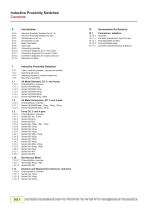
Inductive Proximity Switches Contents Inductive Proximity Switches by ref. no. Inductive Proximity Switches by type Accessories by ref. no. Accessories by type Basic information Type code Connecting variables Connection diagrams DC 3- and 4-pole Connection diagrams DC and AC 2-pole Connection diagrams DC 3-pole push-pull Materials and leads Connectors, adaptors Overview Cordsets (socket-lead, ready-for-use) Field attachable sockets Field attachable plugs Cordsets (socket-lead-plug, adaptors) Inductive Proximity Switches Tasks, mode of operation, requirement profiles Switching behaviour Switching...
Open the catalog to page 2
You will find a further selection from our extensive product range of sensors in the following catalogs: Catalog Section Pulse Sensors and Accessories TK 2 + 12.1 Catalog Section Safety Elements and Accessories TK 5 + 12.2 Catalog Section Ultrasonic Sensors TK 8 Catalog Section Capacitive Sensors TK 9 © by Klaschka GmbH & Co. KG • D-75233 Tiefenbronn • Fon +49 7234 79 0 • Fax +49 7234 79 112 • [email protected] • www.klaschka.d
Open the catalog to page 3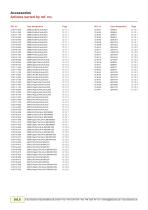
Accessories Articles sorted by ref. no. Ref. no. Type designation Type designation © by Klaschka GmbH & Co. KG • D-75233 Tiefenbronn • Fon +49 7234 79 0 • Fax +49 7234 79 112 • [email protected] • www.kla
Open the catalog to page 6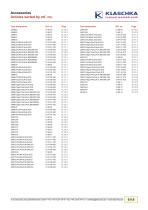
Accessories Articles sorted by ref. no. Type designation Type designation © by Klaschka GmbH & Co. KG • D-75233 Tiefenbronn • Fon +49 7234 79 0 • Fax +49 7234 79 112 • [email protected] • www.klaschka.d
Open the catalog to page 7
Sensors Basic information Sensors are physical-electrical converters, whose task is to acquire measured variables such as distance, pressure and temperature, speed and acceleration and to convert these into an electrical variable. In combination with conrols, these serve for detection of the actual value. Proximity sensors are position sensors that work non-contacting and contactless. They are to a large extent insensitive against environmental influences and do not contain any parts which are subject to wear. We distinguish between switches and analogue sensors. Sensors in machines and plants...
Open the catalog to page 8
Sensors Type code Example of a type code Length of the Connecting Lead in m (optional entry) Display / without LED display B ... F with 2 ... 6 LED displays Type Series: Properties A proximity switch B non-ferrous metal switch C code reader D speed and frequency E foil detection F surface switch G distance sensor H thickness measurement J sensor Number of Sensors per Unit (optional entry) 2 double sensor n multiple sensor, n whole number ≥ 3 Special Characteristics (optional entries, several entries are possible) Co, Pb, Is, Se with field bus interface CANopen, Profibus, Interbus, serial A all...
Open the catalog to page 9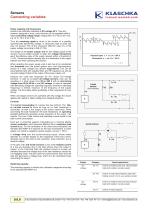
Sensors Connecting variables Power supplies and frequencies Sensors are preferably operated at DC-voltage 24 V. They are, however, designed in such a way that they can be operated within a large connecting voltage range, ranging from 10 V DC to 30 V DC, e.g. at 12, 18 or at 24 V DC. Thus the remaining ripple σ , which is the content of a possibly superimposed alternating voltage, is measured peak to peak and may not exceed 15% of the measured effective value Uv of the supply voltage (according to DIN 41 755). The design of the power supply unit for the voltage supply of the sensors must be stable...
Open the catalog to page 10
Sensors Connection diagrams DC 3- and 4-pole Outgoing lead © by Klaschka GmbH & Co. KG • D-75233 Tiefenbronn • Fon +49 7234 79 0 • Fax +49 7234 79 112 • [email protected] • www.
Open the catalog to page 11
Sensors Materials and leads Plastic material employed as material for housings and mounting parts employed as material for housings and mounting parts; cast resin lead sheath Al Aluminium wrought alloy Material for housings and mounting. Suitable for metal-cutting forming. Transformable and cold-flow pressable. Small specific weight. Colour anodization. It shall be considered that the anodized coat has an insulating effect. Al-DG Aluminium alloyage for die casting Aluminium die cast alloy. Material with low specific weight. Anodizable. The anodized coat has an insulating coat. CuZn Brass Housing...
Open the catalog to page 12
Leads for sensors and as sensor accessories with plug PVC leads Outer diameter of the leads in mm 3.0 3.5 4.5 3.6 shielded 4.6 6.0 shielded Temperature-resistant leads Number x lead cross section in mm^2 Outer diameter of the leads in mm Number x lead cross section in mm^2 Outer diameter of the leads in mm © by Klaschka GmbH & Co. KG • D-75233 Tiefenbronn • Fon +49 7234 79 0 • Fax +49 7234 79 112 • [email protected] • www.klaschka.de
Open the catalog to page 13
Inductive Proximity Switches Tasks, mode of operation, requirement profiles Mode of operation of Inductive Proximity Switches An inductive proximity switch consists of an oscillator with a resonant circuit, rectifier and an output amplifier. The coil of the oscillating circuit determines the size and shape of the "sensing face” of the proximity switch. The oscillator generates a high frequency oscillation, whose alternating field emanates on the open side of the coil and/or the ferrite core. If a metal piece is inserted into this field, energy is absorbed from the oscillating circuit by eddy...
Open the catalog to page 14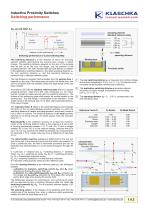
Inductive Proximity Switches Switching performance Actuating element Standard reference plate Operating voltage Voltage drop Hysteresis Switch actuated M 0V Switch not actuated Residual voltage Sensing face The switching distance s is the distance at which an actuating element (object) approaching the sensing face causes a signal change. The switching distance depends on the size of the sensing face as well as on the size, the shape, and the material of the actuating element. The VDE standard 660 part 208 defines in addition to the application switching distance s the rated operating distance...
Open the catalog to page 15All KLASCHKA Sensor & Motion Technologies catalogs and technical brochures
 Detection system WIDENT
9 Pages
 Position Recognition
9 Pages
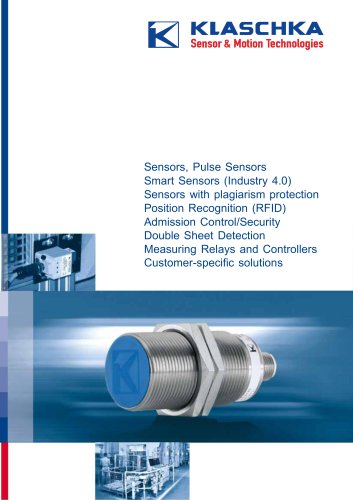 Product Overview
6 Pages
 Klaschka_Measuring Relays_ALME
17 Pages
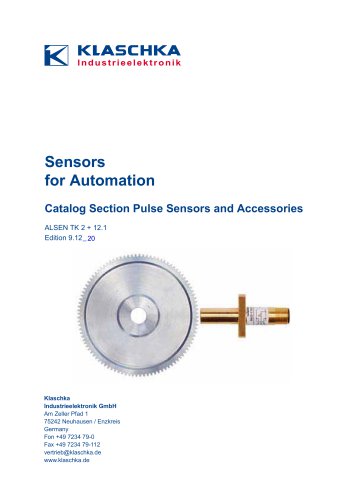 Catalog ALSEN TK2
45 Pages
 Catalog ALSEN TK9
11 Pages

Archived catalogs
 Seam Detection
2 Pages
- Cylindrical proximity sensor
- Inductive proximity sensor
- Frequency inverter
- Monitoring relay
- Threaded proximity sensor
- Compact detector
- Rectangular proximity sensor
- Signal converter
- DIN rail monitoring relay
- Magnetic speed sensor
- Rotational speed sensor
- Analog distance sensor
- Non-contact proximity sensor
- M30 proximity sensor
- Voltage monitoring relay
- Capacitive proximity sensor
- Cylindrical distance sensor
- Hall effect speed sensor