
- Catalogs
- Ventilex BV
- Sludge dryers

Sludge dryers
1 /5Pages

Sludge dryers
1 /5Pages
Catalog excerpts

1/5 Imtech DryGenic helps the waste water industry to dry waste water solids (sludge) in controlled temperature/humidity environment while minimizing utility usage and maximizing production rates. YOUR PARTNER Imtech DryGenic dryers are designed for durability and reliability and control temperature and humidity as required, delivering desired levels even with varying air inlet conditions. DRYING OF PRODUCTS Thermal Drying of Wastewater Solids : Thermal drying is the technology for processing of solids produced at municipal wastewater treatment plants (WWTP). Thermal drying technology, although originally developed for material and chemical processing applications, has been successfully applied to WWTP solids and, thus, it is a viable and proven solids processing technology primarily aimed at producing a marketable product. Thermal drying technology is based on removal of water from dewatered solids which accomplishes both volume and weight reduction. The added benefit of thermal drying is that it typically results in a product with significant nutrient value. Typically, dewatered solids (at approximately 18% to 35% dry solids content) are delivered to a thermal drying system, where most of the water is removed via evaporation resulting in a product containing approximately 90% solids. In the thermal drying system, the temperature of the wet solids mass is raised so that the water is driven off as a vapour. By removing most of the water from the solids, thermal drying results in a significant reduction in both volume and mass. Significant thermal energy must be transferred to the solids to increase temperature in the drying process. This energy can be provided by combustion of a variety of fuels (natural gas, digester gas, heating oil, wood, etc.), by a reuse of waste heat, or by conversion of electrical power into thermal energy. BELT DRYER FOR WASTE WATER SOLIDS (SLUDGE) Waste water treatment plant
Open the catalog to page 1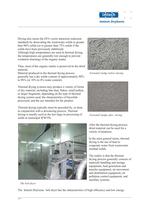
2/5 Drying also meets the EPA vector attraction reduction standards by desiccating the wastewater solids to greater than 90% solids (or to greater than 75% solids if the solids have been previously stabilized). Although high temperatures are used in thermal drying, the temperatures are generally low enough to prevent oxidation (burning) of the organic matter. Thus, most of the organic matter is preserved in the dried material. Material produced in the thermal drying process generally has a dry solids content of approximately 90% to 96% (or 10% to 4% water content). Thermal drying systems may...
Open the catalog to page 2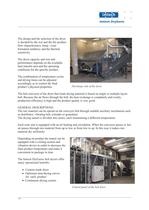
3/5 The design and the selection of the dryer is decided by the wet and the dry product flow characteristics, lump / crust formation tendency and the thermal sensitivity. The dryer capacity and size and performance depends on the available heat transfer area and the operating conditions for the specific product. The combination of temperature cycles and drying times can be adjusted accordingly as to control the final product’s physical properties. The belt conveyor of the dryer that loads drying material is based on single or multiple layers belt. Because the air flows through the belt, the heat...
Open the catalog to page 3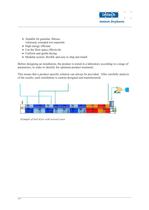
4/5 „h Suitable for granular, fibrous, reformed, extruded wet materials „h High energy efficient „h Use the floor space effectively „h Uniform and gentle drying „h Modular system, flexible and easy to ship and install Before designing an installation, the product is tested in a laboratory according to a range of parameters, in order to identify the optimum product treatment. This means that a product-specific solution can always be provided. After carefully analysis of the results, each installation is custom designed and manufactured. Example of belt dryer with several zones
Open the catalog to page 4
Imtech DryGenic P.O. Box 24002, NL-2490 AA Den Haag tel. +31 70 4523000, fax +31 70 4523003 INTERNET www.drygenic.com e-mail [email protected] DRYAPPL-SLUDGE01ENG.DOC VENTILEX - IMTECH DRYGENIC Ventilex - Imtech Drygenic manufactures the highest quality Fluid bed dryers/ coolers, Belt dryers, Dehumidifiers, Flash dryers, Jet-Bag air filtration and Steam sterilization equipment available. Our equipment is custom designed to meet your highest production standards. Imtech Drygenic.serves the Food, Dairy, Chemical, Pharmaceutical, and Aggregate markets worldwide. Imtech Dygenic belt dryers and coolers...
Open the catalog to page 5All Ventilex BV catalogs and technical brochures
 sugar dryer
4 Pages
 sand dryer
4 Pages
 salt dryer
4 Pages
 Gypsum dryer
4 Pages
 fertilizer dryer
4 Pages
 dry scrubber
4 Pages
 DDGS dryer
4 Pages
 Fluid bed
16 Pages
 POLYKATH SYSTEM
2 Pages
 Sugar Drying Equipment
4 Pages
 Breadcrumb production lines
5 Pages
 Fluid Bed Roasting
4 Pages
 Steriliser
7 Pages
 Almond / Nuts pasteurizer
2 Pages
 Belt dryer
4 Pages
 Imtech Drying Technology
12 Pages




- In-line dryer
- Air dehumidifier
- Air blast dewatering system
- Hot air dryer
- Batch drying system
- Pasteurizer
- Refrigerant dehumidifier
- Heat sterilizer
- Centrifugal drying system
- Dryer for the chemical industry
- Dewatering system with belt conveyor
- Pasteurizer for the food industry
- Dryer for the pharmaceutical industry
- Process sterilizer
- Fluidized bed dryer
- Rotary drum dryer
- Steam sterilizer
- Sterilizer for the food industry
- Cooler dryer