


Tube Expansion Issues and Methods
1 /4Pages

Tube Expansion Issues and Methods
1 /4Pages
Catalog excerpts

TUBE EXPANSION ISSUES AND METHODS Compiled by Mark Bloodworth HydroSwage Product Manager Haskel International Inc. [email protected] Tight, durable seating of tubes in tubesheets is one of the critical functions in manufacturing heat exchangers for high pressure steam generators, boilers for conventional power generation, food and pharmaceutical processing systems and condensers. In selecting the best method for expanding the tube within the sheet, producers must examine factors including safety, speed, cost, operator skill requirements, repeatability and overall quality. With the number of tubes in a sheet ranging from the hundreds to tens of thousands, and the expansion process being done manually one by one, the stakes for achieving the best balance of quality and cost are high. This article will explore how the four common expansion, or swaging, methods in common use – two hydraulic and two mechanical – meet those key considerations in various applications. Tube & Tubesheet Issues As a general rule the smaller the clearance the better, from the expanding point of view, no matter what expanding method is used. What establishes the clearance used by manufacturers is their ability to stuff the tubes through the tubesheets and baffles. This varies with the size of the structure, its configuration and the tube diameter. From a practical standpoint, the best quality will be obtained by using the TEMA Special Close Fit drilling tolerances and adhering to tubing manufactured in complete conformity with Section II of the ASME code. To some degree, all tube-to-tubesheet joints leak. While welded expanded joints are the most leak resistant, Hydrogen may pass through welded joints. When welding the tubes to the front face of the tubesheet for tightness or strength, subsequent expanding beginning about 3/8" to 1/2" beyond the weld should be called out to avoid failure of the welds which may result due to cyclical loads from vibration or various loadings to which the tubes are subject. Axial scratches in the hole or tube material will cause leaks in any expanded tube to tubesheet joints, regardless whether expanding by rolling, near contact explosions, compressing a rubber expander, or by hydro-expanding. Therefore, it is recommended that scratched holes be reworked to be free of axial scratches or an optimal groove be cut into the tubesheet. Tube Expansion Methods By expanding the tube inside the tubesheet, swaging ensures that the space between the two components is always forced closed. Hydraulic expansion is the direct application of high internal pressure within a tube or sleeve in order to form a tight joint between the tube and tube sheet or a tight seal between the sleeve and tube. Two processes are used to accomplish such expansions: „h In direct hydraulic expansion, the tube is sealed at its expansion zone ends and fluid pressure is applied directly to the inside surface of the tubular section being expanded.
Open the catalog to page 1
„h Explosive expansion involves an explosive charge inside the tubular running the length of the tubular that is sealed on both ends. A charge is detonated and the pressure generated expands the tubular out against the existing casing. The outside is generally sealed to the existing casing with a layer of fiberglass impregnated resin. A mandrel may then be pulled through the expanded liner to complete the expansion process.(5) In mechanical rolling, a set of hardened rolls in a cage rotate around a tapered mandrel. The rolls travel up the mandrel causing an increasing radial force exerted at...
Open the catalog to page 2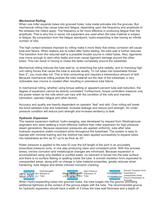
Mechanical Rolling When one roller expands tubes into grooved holes, tube metal extrudes into the grooves. But mechanical rolling may cause tube-end fatigue, depending upon the frequency and amplitude of the stresses the rollers apply. The frequency is far more effective in producing fatigue than the amplitude. That is why five or seven roll expanders are used when the tube material is subject to fatigue. By comparison from the fatigue standpoint, hydro-expanding is like having an infinite number of rolls. The high contact stresses imposed by rolling make it more likely that stress corrosion...
Open the catalog to page 3
0.2 times (20%) of the tube wall thickness. The recommended shape of the groove is rectangular and the edges of the groove need to be clean and square with no interruptions. Hydro-expanding produces no surface effects on the tube and almost no work-hardening. Bell shaped or hour glass shaped tube ends never occur and the tube-to-wall contact is always uniform. Hydraulic expanding leaves no residue and does not change the appearance of the tube ends because de-ionized water is used to expand the tubes. Used consistently and successfully on both non-weld and welded joints, it is successful in out-of-round...
Open the catalog to page 4All Haskel catalogs and technical brochures
 Subsea Valves
18 Pages
 Hydrogen Valves
8 Pages
 Pneumatic Liquid Pump
28 Pages
 Refrigerant Pumps
2 Pages
 Butech Oil Gas
12 Pages
 Air Pressure Amplifiers
12 Pages
 2019 Haskel Product Overview
4 Pages
 H-Drive Cut Sheets
2 Pages
 Mini Charging Cart
2 Pages
 Fire Fighting Safety
12 Pages
 HGD-90
2 Pages
 HGD-150
2 Pages
 HGT-90/63
2 Pages
 HGT-150/63
2 Pages
 HGT-150/90
2 Pages
 Bootstrap Nitrogen Boosters
2 Pages
 ScubAmp
2 Pages
 Oxygen Boosters
2 Pages
 Oil and Gas
6 Pages
 Air Pressure Amplifers
12 Pages
 H-Drive
4 Pages
 Oil & Gas
6 Pages
 Gas Boosters
36 Pages
 Air Pressure Amplifier
12 Pages
 Liquid Pumps
28 Pages


Archived catalogs
 Haskel Air Amplifier Literature
12 Pages
 BuTech Subsea Valves
32 Pages
 Airline Industry
4 Pages
 2015 Haskel Product Overview
4 Pages
 Breathing Air Compressor
2 Pages


- Haskel pump
- Haskel industrial pump
- Haskel water pump
- Haskel chemical pump
- Transfer pump
- Haskel compact pump
- Haskel pneumatic pump
- Haskel piston pump
- Metering pump
- Materials handling pump
- High-pressure pump
- Haskel intrinsically safe pump
- Large pump
- Heating pump
- Gas pump
- Fluid pump
- Solvent pump
- Haskel pressure booster
- Mixing pump
- Haskel gas pressure booster