
 Website:
Ecotech
Website:
Ecotech
Group: ACOEM


Catalog excerpts

WINAQMS Data Acquisition & Control System
Open the catalog to page 1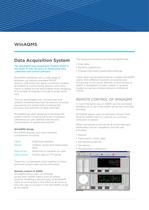
Data Acquisition System The WinAQMS Data Acquisition System (DAS) is the result of over 30 years of developing data collection and control software. WinAQMS interfaces with a wide range of analysers via industry standard RS232 serial or USB protocols. Serial connection enables WinAQMS to communicate directly with instru- ments in digital format and enables multi-dropping of a number of analysers through a single seria This has advantages over conventional A/D systems including reducing the amount of wiring required by the system and increasing the accuracy and precision of data collected...
Open the catalog to page 2
Powerful remote control functions This remote access can also be used when visiting an AQM station, the WinAQMS client can be used to access other stations within the network, making each station a terminal within the AQMS network. One of the main benefits of remote control of nstruments and servers is the ability to perform remote calibrations. This feature provides users with the ability to perform individual calibrations from the office or home without spending hours travelling to a site. In the case of onsite visits, calibrations can be performed for the next site visit from the current...
Open the catalog to page 3
Additional features EXCEEDANCE ALARMS WinAQMS can be configured to send alarms for exceedences or predefined user ranges for any parameter. These alarms can be sent • To another device via serial port or digita CALCULATED CHANNELS Calculated channels allow users to create a new channel (parameter) based on a calculation performed on a different parameter • A wide variety of calculations can be performed • New channels that are offset or compensated for, due to specific events or influences • Allows data to be converted into different units MULTI LANGUAGE SUPPORT • WinAQMS is available in...
Open the catalog to page 4All Ecotech catalogs and technical brochures
-
 Operations & Maintenance
12 Pages
-
 Environmental Monitoring
16 Pages
-
 ORION
ORION6 Pages
-
 VOC1000
1 Pages
-
 FUSION
6 Pages
-
 DUO
DUO6 Pages
-
 CUBE
CUBE6 Pages
-
 NO2 Analyser
8 Pages
-
 Serinus 51 SO2/H2S Analyser
2 Pages
-
 BLAST MONITORING Solutions
4 Pages
-
 Serinus Cal
8 Pages
-
 SPECTRONUS analyzer
12 Pages
-
 ECOTECH Company Profile
16 Pages
-
 WINAQMS
4 Pages
-
 PROTINUS 1000
2 Pages
-
 NH3 Analyser Serinus 44
2 Pages
-
 EC9843 NOy analyzer
2 Pages
-
 EC9820T CO2 trace analyzer
2 Pages
-
 SO2 Analyser EC9850T
2 Pages
-
 SO2 Analyser EC9850
2 Pages
-
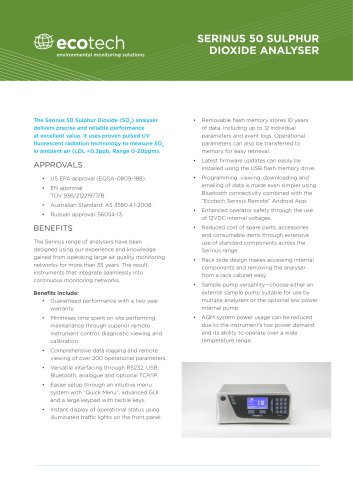 SO2 Analyser Serinus 50
2 Pages
-
 NOx EC9841AS
2 Pages
-
 NOx EC9841
2 Pages
-
 CO Analyser EC9832
2 Pages
-
 CO Analyser Serinus 30H
2 Pages
-
 CO Analyser Serinus 30
2 Pages
-
 Serinus 10
2 Pages
-
 SERINUS Gas Analyser Series
4 Pages
-
 GasCal 1100 gas calibrator
2 Pages
-
 Serinus 10 Ozone Analyzer
2 Pages
-
 HiVol 3000 PUF Sampler
2 Pages
-
 HiVol 3000 XAD Sampler
2 Pages
-
 Converters
2 Pages


Archived catalogs
-
 Environmental Monitoring
16 Pages
-
 Corporate Profile
6 Pages
-
 EC9830T CO trace analyzer
2 Pages
-
 EC9811 Ozone photometer
2 Pages
-
 EC9841T NOx trace analyzer
2 Pages


