

- Company
- Products
- Catalogs
- News & Trends
- Exhibitions
Design Challenges with Piezo-Actuation
1 /1Page
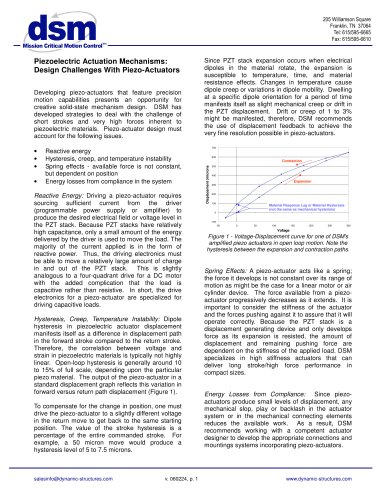
Design Challenges with Piezo-Actuation
1 /1Page
All DSM catalogs and technical brochures
 MD-90 Motor Driver
1 Page
 SA-500
1 Page
 VF-500 Voltage Follower
1 Page
 VF-90 Voltage Follower
1 Page
 Model ZSA-1000C
1 Page
 Model XSA-0200C
1 Page
 DSM Model I-20
1 Page
 SUM-40
1 Page
 XRS1-800/1600
3 Pages
 PKA-ZPR-200
1 Page
 PKA-XYZ-400
1 Page
 TTA-1200
1 Page


Archived catalogs


Related Searches
- Positioning table
- Translation stage
- Motorized positioning table
- Precision positioning table
- Single-axis positioning stage
- Manually-operated positioning stage
- 2-axis positioning table
- Rotary positioning table
- Piezoelectric stage
- 3-axis positioning table
- Actuator controller
- Piezoelectric actuator
- Linear piezoelectric actuator
- Long-travel positioning stage
- Linear actuator controller
- Amplified piezoelectric actuator
- Nanopositioning stage
- Linear nanopositioning stage
- Piezoelectric motor
- Linear piezoelectric motor
*Prices are pre-tax. They exclude delivery charges and customs duties and do not include additional charges for installation or activation options. Prices are indicative only and may vary by country, with changes to the cost of raw materials and exchange rates.