See other catalogues for
DSM
You may also be interested in
Text version of the page
| | | | | | | | | | | | | | | | | | | | | | | | |
| | | |
| | | dsm - Mission Critical Motion Control - | | |
| | | !05 Williamson Square Franklin. TN 37064 Tel: 615/595-6665 Fax: 615/595-6610 | | |
| | | |
| | | |
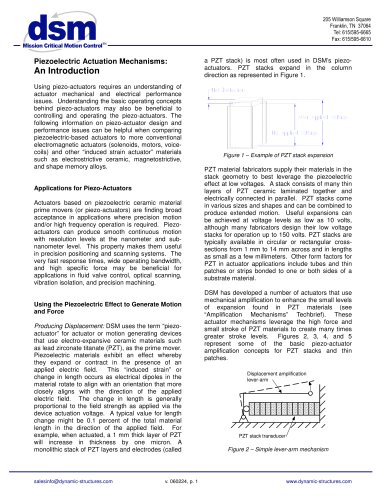
| | | a PZT stack) is most often used ii actuators. PZT stacks expand i direction as represented in Figure 1. | | |
| | | Piezoelectric Actuation Mechanisms: An Introduction | | |
| | | |
| | | |
| | | | | |
| | | |
| | | Figure ! - Example of PZT slack expansion PZT material fabricators supply their materials in the stack geometry to best leverage the piezoelectric effect at low voltages. A stack consists of many thin layers of PZT ceramic laminated together and electrically connected in parallel. PZT stacks come in various sizes and shapes and can be combined to produce extended motion, useful expansions can be achieved at voltage levels as low as 10 volts, although many fabricators design their low voltage stacks for operation up to 150 volts. PZT stacks are typically available in circular or rectangular cross-sections from 1 mm to 14 mm across and in lengths as small as a few millimeters. Other form factors for PZT in actuator applications Include tubes and thin patches or strips bonded to one or both sides of a substrate material. DSM has developed a number of actuators that use mechanical amplification to enhance the small levels of expansion found in PZT materials (see "Amplification Mechanisms" Techbrief). These actuator mechanisms leverage the high force and small stroke of PZT materials to create many times greater stroke levels. Figures 2, 3, 4, and 5 represent some of the basic piezo-actuator amplification concepts for PZT stacks and thin patches. | | |
| | | Applications for Piezo-Actuators Actuators based on piezoelectric ceramic material prime movers (or piezo-actuators) are finding broad •.coop-.aicc i-i aooiior.lioi1;. ■■.'.■■i'oi::: precision -roiicn and/or high frequency operation is required. Piezo-actuators can produce smooth continuous motion with resolution levels at the nanometer and sub-nanometer level. This property makes them useful in precision positioning and scanning systems. The very fast response times, wide operating bandwidth, and high specific force may be beneficial for applications in fluid valve control, optical scanning, vibration Isolation, and precision machining. | | |
| | | |
| | | Using the Piezoelectric Effect to Generate Motion and Force Producing Displacement: DSM uses the term "piezo-actuator" for actuator or motion generating devices that use electro-expansive ceramic materials such as lead zirconate titanate (PZT), as the prime mover. Piezoelectric materials exhibit an effect whereby they expand or contract in the presence of an applied electric field. This "induced strain" or change in length occurs as electrical dipoles in the material rotate to align with an orientation that more closely aligns with the direction of the applied electric field. The change in length is generally proportional to the field strength as applied via the device acluation voltage. A typical value for length change might be 0.1 percent of the total material length in the direction of the applied field. For example, when actuated, a 1 mm thick layer of PZT will increase In thickness by one micron. A monolithic stack of PZT layers and electrodes {called | | |
| | | |
| | | | | | | | | | | | | | | r-v- | I | | | | | t | | | | | | | | | iJL | | | | A | / | | | | / / / | •V ////// | / | / | | | | | | | | | | | | |
| | | |
| | | PZT stack transducer' | | |
| | | |
| | | Figure 2 - Simple lever-arm mechanism | | |
| | | |
| | | 060224, p. 1 | | |
| | | |
| | | | | | | | | | | | | | | | | | | | | | | | |