
- Catalogs
- Thermo Fisher Scientific - Industrial & Applied S
- Surge Suppressor

Surge Suppressor
1 /19Pages

Surge Suppressor
1 /19Pages
Catalog excerpts
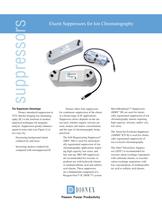
suppressors The Suppressor Advantage > MicroMembrane Suppressors (MMS Dionex introduced suppression in 1975, thereby bringing ion chromatog- raphy (IC) to the forefront of modern analytical techniques for inorganic analysis. Suppression greatly enhances signal-to-noise ratio (see Figure 2) in two ways by: > ٙ III) are used for chemi-cally regenerated suppression of ion chromatography eluents requiring high capacity, solvents, and/or very low noise. > The Anion Ion-Exclusion Suppressor (AMMS > ICE II) is used for chemi-cally regenerated suppression of ion-exclusion chromatography. Decreasing background eluent conductivity and noise > The Self-Regenerating Suppressor > ή (SRS > 300) is used for electrolytic-ally regenerated suppression of ion chromatography applications requir- ing high capacity, low noise, and fast start-up. SRS 300 suppressors are recommended for isocratic or gradient use with hydroxide eluents or methanesulfonic acid and sulfuric acid eluents. These suppressors are a fundamental component of a Reagent-FreeΙ IC (RFIC) system. > Increasing analyte conductivity compared with nonsuppressed IC Dionex offers four suppressors for continuous suppression of the eluent in a broad range of IC applications. Suppressor choice depends on the elu- ent used, whether organic solvents are used, analyte and matrix concentration, and the type of chromatography being practiced: > The Atlas > ٮ Electrolytic Suppres-sor (AES > ) is recommended for isocratic anion-exchange separations with carbonate eluents, or isocratic cation-exchange separations with low concentrations of methanesulfo- nic acid or sulfuric acid eluents. >
Open the catalog to page 1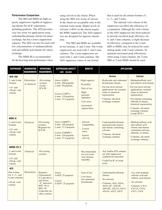
Anions Cations Anion (ASRS): 4-mm: 200 eq/min 2-mm: 50 յeq/min Cation (CSRS > SUPPRESSOR REGENERATION OPERATIONAL SUPPRESSION CAPACITY BENEFITS APPLICATIONS REQUIREMENTS REQUIREMENTS [mN] > [mL/min] SRS 300 Anion (AMMS > ): 4-mm: 110 eq/min 2-mm: 37.5 յeq/min- High capacity- Versatility - Ease of use - High- pressure operation- Low noise - electrolytic regeneration - Methanesulfonic acid and sulfuric acid eluents- For low-level solvent applications, external water or chemical regeneration- For eluents containing chloride or nitrate, chemical regeneration.- Columns: all cation exchange columns...
Open the catalog to page 3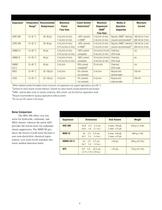
Suppressor Temperature Recommended Maximum Eluent Solvent Maximum Modes of Maximum Range > 1 Backpressure Eluent Restrictions > 2 Regenerant Operation Current Flow Rate EWM > 3 Supported Flow Rate ASRS 300 1535 C 30ږ40 psi 3 mL/min (4 mm), <40% solvents 5 mL/min (4 mm) Recycle, EWM > 3 , chemical 100 mA for 2 mm, 1 mL/min (2 mm) in EWM > 3 2 mL/min (2 mm) (recycle recommended) > 4 300 mA for 4 mmCSRS 300 1540 C 30ږ40 psi 3 mL/min (4 mm), <40% solvents 5 mL/min (4 mm) Recycle, EWM > 3 , chemical 100 mA for 2 mm, 0.75 mL/min (2 mm) in EWM > 3 2 mL/min (2 mm) (recycle recommended) > 4 300 mA for...
Open the catalog to page 4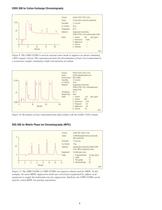
j . Volume: 25 LTemperature: 40 հC Detection: Suppressed conductivity, CSRS ULTRA ,4 mm, external water modePeaks: 1. Sodium 100 mg/L (ppm) 2. Ammonium 0.025 3. Magnesium 4. Calcium ח 5. Unknown Column: IonPac CG15, CS15, 4 mmEluent: 10 mN sulfuric acid/ 9% acetonitrile Flow Rate: 1.2 mL/min In 00.32S 05 12345101520Minutes > 13901 Column: IonPac CG16, CS16, 5 mm Eluent: 26 mN methanesulfonic acid Eluent Source: EGC II MSA Flow Rate: 1.5 mL/min In j . Volume: 10 LDetection: Suppressed conductivity, CSRS ULTRA, 4 mm, Autosuppression recycle mode Temperature: 30 ՋC Sample Prep: Filter Peaks: 1....
Open the catalog to page 8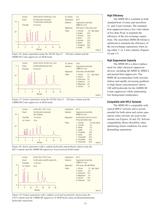
Column: IonPac AG14A, AS14A-5m, 3 mmEluent: 8.0 mM sodium carbonate/ 1.0 mM sodium bicarbonateFlow Rate: 0.5 mL/min In j . Volume: 5 յLTemperature: 30 C Detection: Suppressed conductivity, AMMS III, 2 mmRegenerant: DCR mode, 72 mN sulfuric acid Peaks: 1. Fluoride 5.0 mg/L (ppm) 2. Acetate 20.0 3. Chloride 10.0 4. Nitrite 15.0 5. Bromide 25.0 6. Nitrate 25.0 7. Phosphate 40.0 8. Sulfate 30.0 > Column: IonPac CG12A, CS12A-5 m, 3 mmEluent: 20 mM methanesulfonic acid Flow Rate: 0.5 mL/min In j . Volume: 25 LDetection: Suppressed conductivity, CMMS III, 2 mmRegenerant: DCR mode, 100 mM TBAOH Peaks:...
Open the catalog to page 11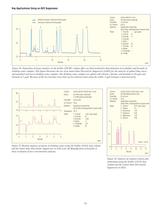
j . Volume: 225 LDetection: Suppressed conductivity, Anion Atlas, AutoSuppression recycle mode Peaks: 1. Fluoride - յg/L (ppb) 2. Chlorite 10 3. Bromate 5 4. Chloride - 5. Nitrite - 6. Bromide 10 7. Chlorate 10 8. Nitrate - 9. Phosphate - 10. Sulfate - Column: IonPac AS9-HC, 4 mmEluent: 9.0 mM sodium carbonate Flow Rate: 1.0 mL/min In 10987 65 4 32 1Spiked Sunnyvale, California drinking waterSunnyvale, California drinking water 24 S 23 0510152025Minutes > 16224 Column: IonPac AG14A, AS14A-5m, 3 mmEluent: 8.0 mM sodium carbonate 1.0 mM sodium bicarbonateFlow Rate: 0.8 mL/min In Column: IonPac...
Open the catalog to page 15All Thermo Fisher Scientific - Industrial & Applied S catalogs and technical brochures
 Remel Spectra-VRE
2 Pages
 Vanquish Duo UHPLC Systems
12 Pages
 Vanquish UHPLC System
16 Pages
 EASY-nLC 1200 System
8 Pages
 Dionex Product Selection Guide
436 Pages
 Dionex ICS-5000+ HPIC System
20 Pages
 Dionex IC Solutions
8 Pages
 Chemicals for a Global Market
16 Pages
 Dionex Product Selection Guide
340 Pages
 ICS-900 Brochure
4 Pages
 ICS-2100/1600/1100
8 Pages
 Combustion IC System
4 Pages
 AutoTrace SPE Instrument
6 Pages
 ICS-3000 System
16 Pages
 Reagent-Free Ion Chromatography
12 Pages
 Virtual Column
8 Pages


Archived catalogs
 Ion Chromatography
16 Pages

- Automation software solution
- Liquids analyzer
- Automatic analyser
- Benchtop analyser
- Spectrometer
- Continuous analyzer
- Water analyzer
- Laboratory analyzer
- Compact analyzer
- Laboratory spectrometer
- Thermo Fisher chromatograph
- Analyzer for the food industry
- Thermo Fisher laboratory chromatograph
- Compact detector
- Mass spectrometer
- Process detector
- Electrochemical detector
- Electrochemical analyzer
- Conductivity analyzer
- Thermo Fisher automatic sampler