


- Products
- Catalogs
- News & Trends
- Exhibitions
Quick Wins for Energy Savings in Buildings

Quick Wins for Energy Savings in Buildings
HVAC systems in the UK consume 35% of the country's energy, with air filters accounting for 30% of this consumption. Switching to Low Energy Air Filters can save £500 million annually in the UK by reducing energy consumption by 30%.
Business Challenge
Organizations are increasingly focusing on energy plans that balance sustainability, financial viability, and social responsibility. Effective air filtration systems offer significant energy savings, with paybacks typically under three months.
The Solution
Low Energy Air Filters reduce the resistance in HVAC systems, leading to lower energy costs. These filters maintain airflow longer, require fewer changes, and reduce waste. Camfil's Life Cycle Cost (LCC) analysis helps quantify savings and demonstrate the benefits of switching to low energy filters.
Cost Saving Example
In a typical building with 20 air handling units, upgrading to low energy air filters can save £14,000 annually. Additional savings include reduced labor and waste costs, and a reduction in CO2 emissions.
No Compromise on Air Quality
Low energy air filters maintain high indoor air quality by using fine fibers to trap smaller particles. The Eurovent energy classification system helps select filters for optimal energy efficiency and air quality.
Summary
Camfil's low energy air filters offer significant energy savings and high air quality, contributing to sustainability and cost efficiency. With rising energy prices, these filters are a crucial part of energy-saving strategies.
Catalog excerpts

QUICK WINS FOR ENERGY SAVINGS IN BUILDINGS Choosing low energy air filters for both optimised energy performance and indoor air quality February 2014
Open the catalog to page 1
Quick wins for energy savings in buildings Choosing low energy air filters for both optimised energy performance and indoor air quality _________________________________________________________________________________ Executive Summary HVAC systems heat cool and clean the air distribution within some 200,000 buildings in the UK. That’s approximately 7,300 organisations consuming 35% of the UK’s energy consumption. The Federation of European Heating, Ventilating and Air-Conditioning Associations have estimated that within the EU there is a potential annual saving of 5TWh available by switching...
Open the catalog to page 2
Camfil know that saving energy is one of the most challenging tasks facing the built environment today. Our low energy air filter products provide the highest indoor air quality, with the lowest pressure drop, which deliver the biggest energy savings to customers, without compromising air quality. Property, Estates, FMs, Building and Energy Managers are realising the substantial financial and energy saving opportunities that exist by replacing existing air filters with our award winning filters. In 2013 we delivered ‘identified energy savings’ of over £1 million to UK sites by installing low...
Open the catalog to page 3
The Solution Air filters are hidden in various plant rooms within the air handling unit, they significantly contribute to the resistance of the fan motor. Air filters are designed to be changed unlike other components within the ventilation system, and consequently do not put any pressure on capital budgets when upgrading to a low energy filter. Would you spend a pound to save £5 or £10? Camfil can demonstrate how better air filters will lower Total Cost of Ownership (TCO). Low cost filters clog quickly, causing a higher resistance to the airflow which results in an energy cost penalty. Camfil...
Open the catalog to page 4
terms of installation, these low energy air filters in 90% of cases can be retro fitted in the existing framework which means that payback is usually 1-3 months. In other cases, new framework may need to be installed with the low energy air filters and the payback is extended but always within a 12 month revenue period. In our experience, these upgrades are resourced within the revenue budget with no need for capital expenditure. Placement of low energy air filters in air conditioning systems enhance the system efficiency by maintaining the heat transfer efficiency of the heating and cooling...
Open the catalog to page 5
The Life Cycle Cost for a filter is the cost of the: Labour (installing and replacing) Energy consumption Cleaning of ventilation system Disposal of used filters_ The cost saving example In a typical building, for example a hotel, containing 20 air handling units (AHU's) installed with 10 filters in each (200 pre and secondary air filters) energy savings can typically amount to £14,000 per year, every year, simply by upgrading to low energy air filters. Other savings include • 50% labour time (you only change half as many filters) • 50% waste costs (you only dispose of half as many filters) •...
Open the catalog to page 6
No compromising on air quality The function of an air filter in air conditioning applications is to clean the air that we breathe to a prescribed level. (F7: minimum class filters to EN779:2012) In order to achieve this, the air filter must perform at this level throughout its installed lifetime. Only filters that are manufactured using fine fibres can reliably perform at this level as the interstitial holes between the fibres are smaller and will trap smaller particles. It is this balance of fine fibres and engineered construction that allows a low energy air filter to deliver optimised energy...
Open the catalog to page 7
consumption and environmental impact for sustainability reasons, building owners also need to cut operating costs as power prices increase. Selecting the right quality air filters with the lowest energy consumption can boost their energy efficiency and also increase lAQfor a better and healthier work environment. European buyers of filters should check that their supplier is Eurovent-certified. There should be Eurovent labels on all filter boxes and filters should have test protocols based on £fHO£NO CLASS Nominal airflow Annual Energy Consumption: * Eurovent Certification Company is the representative...
Open the catalog to page 8
Summary With 50 years of experience in air filtration products and solutions, Camfil delivers value to customers all over the world while contributing to something essential to everyone – clean air for health, well-being and performance. Our products address the energy considerations that all organisations face. In 2013 we supported site and energy teams, in estates across the UK, presenting opportunities for Engineers to deliver identified energy savings (Over £1million) for clients and stakeholders. This is supported by high profile case studies. Our filters deliver the required air quality,...
Open the catalog to page 9
About Camfil The Camfil Group is a world leader in the development and production of air filters and clean air solutions. Camfil is also one of the most global air filtration specialists in the world with 23 production units and R&D centres in the Americas, Europe, South East Asia and the Asia-Pacific region. The Group, headquartered in Stockholm, Sweden, has 3,428 employees and sales in the range of SEK 4.9 billion. International markets account for almost 90% of sales. The company’s business is to provide customers with sustainable best-in-class air filtration products and services through...
Open the catalog to page 10All Camfil catalogs and technical brochures
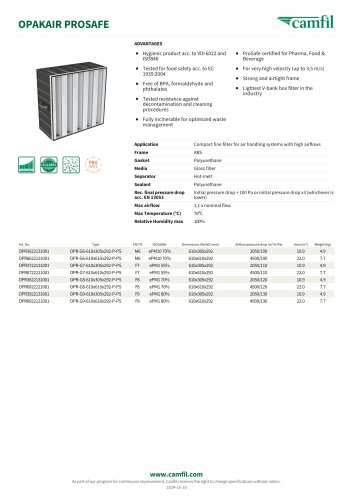
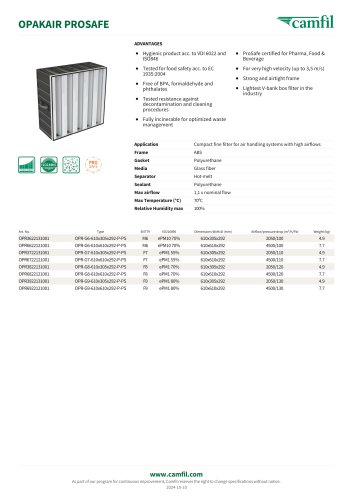 OPAKAIR PROSAFE
1 Page
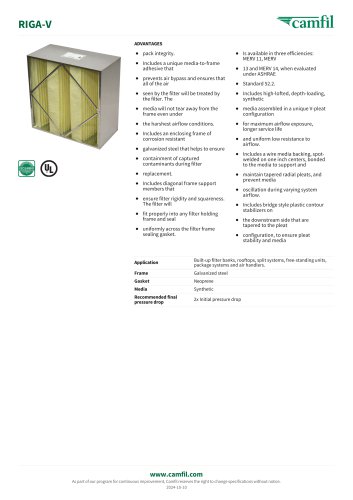 RIGA-V
1 Page
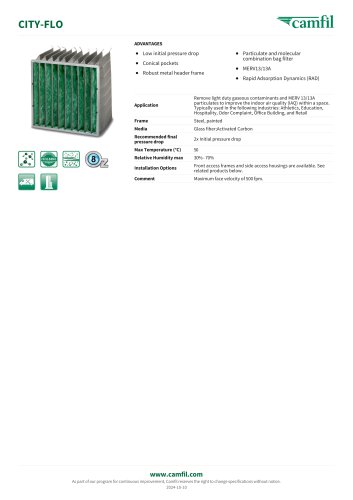 CITY-FLO
1 Page
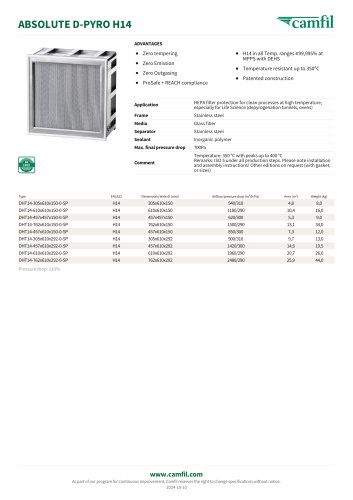 ABSOLUTE D-PYRO H14
1 Page
Archived catalogs
 MEGALAM ES PROSAFE
2 Pages
 CITY-FLO XL
2 Pages
 CITY M
9 Pages
 Food and Beverage Industry
16 Pages
 Life science Industry
16 Pages
 Camfil Product Catalogue
154 Pages
 CamCleaner
10 Pages
 Clean Process
6 Pages
 Energy Hero
5 Pages
 Absolute
4 Pages
 Food processing industry
8 Pages


- Liquid filter
- Filter cartridge
- Camfil industrial filter
- Pressure separator filter
- Camfil stainless steel filter
- Industrial filter cartridge
- Fine filter cartridge
- Water pre-filter
- Dust collector
- Filtration unit
- Filter housing
- Plastic filter cartridge
- Camfil panel filter
- General purpose filter cartridge
- Camfil compact filter
- Filter element
- Filter dust collector
- Metal filter housing
- Gas separator filter
- Process filter