
- Catalogs
- Bruker Daltonics
- Brochure BioTools 2.2

Brochure BioTools 2.2
1 /10Pages

Brochure BioTools 2.2
1 /10Pages
Catalog excerpts

Component of Mass Spectrometry-Based Proteomics Suite Software for Protein Data Interpretation biotools 2.2 > Enabling Life Science Tools Based on Mass Spectrometry size="-2">
Open the catalog to page 1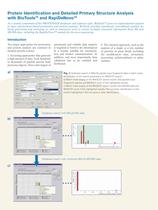
As a central component of the PROTEINEER hardware and software suite, BioTools gives an unprecedented support to mass spectrometry-based proteomics and protein analysis. BioTools provides automated, user-defi ned routines for batch processing and screening, as well as interactive tools to extract in-depth structural information from MS and MS/MS data, including the RapiDeNovoٙ module for de novo sequencing. > Two major approaches for proteomics and protein analysis are common in modern protein science:1. Screening approaches that generate a high amount of data, from hundreds to thousands of peptide...
Open the catalog to page 2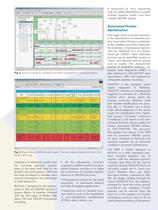
de novo sequencing with the added RapiDeNovo module yielding sequence results even from complex MS/MS spectra. > One major focus in protein chemistry is the identifi cation of unknown pro-teins from either 2D-gels or solutions. In the standard proteomics approach, the proteome is fractionated and pro- teins are displayed in a two dimen- sional gel (2DGE). Here individual proteins can be quantifi ed, picked as spotsӔ and digested with an enzyme such as trypsin. The characteristic pattern of proteolytic peptides, the peptide mass fi ngerprint (PMF), is then obtained by MALDI-TOF mass spectrometry...
Open the catalog to page 3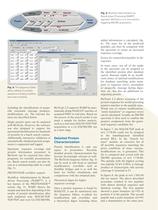
Fig. 4: Workfl ow Administration by Result-driven Processing (WARP) approach. BioTools is in a core position triggering MS/MS acquisitions. added information is calculated (fi g. 6). The mass list of the predicted peptides can then be compared with the spectrum to create an increased sequence coverage. Screen for unmatched peptides in the sequence In most cases, not all of the peaks in the spectrum can be assigned to the identifi ed protein after database search. Reasons might be an insuffi -cient choice of optional modifi cations for database searching, point muta- tions or sequence errors,...
Open the catalog to page 4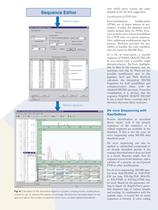
tion which gives exactly the same peptide as for the fi rst suggestion. Post-translational modifi cations (PTMs) are of major interest in pro- teomics. Usually, the database search results include hints for PTMs. How- ever, in many cases various possibilities for a PTM exist on a given sequence. Also, additional modifi cations may be present. BioTools provides the pos- sibility to localize the exact modifi ca-tion site based on MS/MS data.In a hit of beta-casein, a peptide sequence of FQSEE QQQTE DELQD K was found with a possible single phosphorylation. BioTools highlights this in blue in the...
Open the catalog to page 5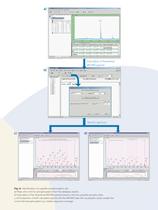
Fig. 9: Identifi cation of a peptide phosphorylation site. a) Peak with a hint for phosphorylation from the database search. b) Calculation of the theoretical MS/MS spectra based on the two possible phospho-sites. c, d) Comparison of both calculated spectra with the MS/MS data: the visualization easily reveals the correct Ser-phosphorylation by a better sequence coverage. >
Open the catalog to page 7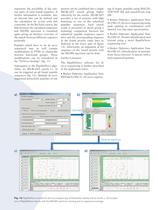
De novo sequencing using peak parking in combination with nanoLC-ion trap mass spectrometry Bruker Daltonics Application Note #LCMS-41, Protein identifi cation and beyond using a novel RapiDeNovo sequencing toolՕ Bruker Daltonics Application Note #LCMS-43, Identifi cation of proteins from Taxus baccata : A species with a non-sequenced genome The RapiDeNovo software for de novo Further Literature sequencing is further described in the application notes: Bruker Daltonics Application Note #MT-66/LCMS-37, De novo sequenc- ing of tryptic peptides using MALDI-TOF/TOF MS and nanoESI-ion trap MSՕ Bruker...
Open the catalog to page 8
de novo sequencing is performed with the RapiDeNovo module. Subsequent MS-BLAST homology search is supported. BioTools features batch result reporting in MTP viewer and HTML format, and Մcopy and paste export of displayed items, e.g. spectra, sequence maps, and search results, into reports and offi ce documents. > ӕ Protein identifi cation is supported as a batch process, using peptide mass fi ngerprint (PMF), MALDI- and ESI-MS/MS data. Effective viewing and judgment of individual PMF and MS/MS results is possible giving interactive access to candidate lists, spectra, informa- tion from database...
Open the catalog to page 9
BDALDE 09 04, LS-4 www.bdal.de www.bdal.com Bruker Daltonik GmbH Bruker Daltonics Inc. Bremen GermanyPhone +49 (421) 2205-0Fax +49 (421) 2205-104E-Mail [email protected] Billerica, MA USAPhone +1 (978) 663-3660Fax +1 (978) 667-5993E-Mail [email protected] See our website for worldwide sales and service contacts. >
Open the catalog to page 10All Bruker Daltonics catalogs and technical brochures
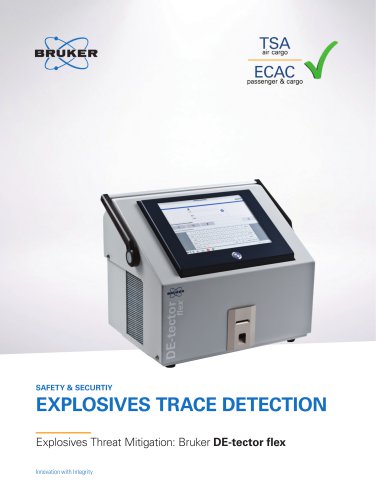 DE-tector flex
8 Pages
 MATRIX II-MG
8 Pages
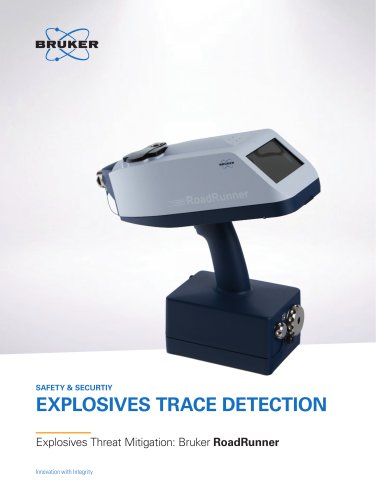 RoadRunner
8 Pages
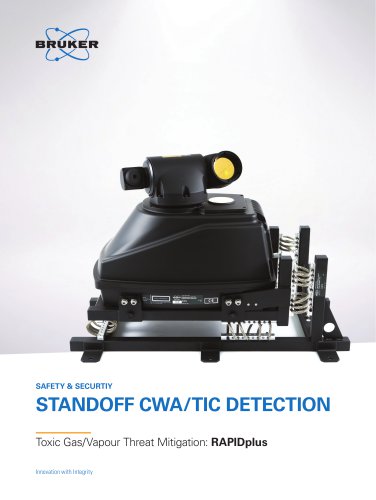 RAPIDplus
12 Pages
 RAID-XP
8 Pages
 Maritime Detection Systems
7 Pages
 SVGps
SVGps4 Pages
 TIMON
TIMON13 Pages
 MALDI Biotyper® CA System
12 Pages
 RAID-M Series
7 Pages
 HDX Solution
2 Pages
 EVOQ GC-TQ
8 Pages
 timsTOF PRO
8 Pages
 Agri Solutions brochure
8 Pages
 PesticideScreener
8 Pages
 Elute LC series
8 Pages
 nanoElute®
6 Pages
 timsTOF™
8 Pages
 rapifleX™
8 Pages
 amaZon SL
6 Pages
 compact
8 Pages
 MALDI Biotyper
56 Pages
 rapifleX™ MALDI Tissuetyper™
8 Pages
 MALDI PharmaPulse™
4 Pages
 Toxtyper
6 Pages
 impact II
12 Pages
 maxis II
12 Pages
 amaZon speed
10 Pages
 Albira Brochure
12 Pages
 prime
prime12 Pages
 solarix
10 Pages
 Metabolomics
12 Pages
 aurora M90
10 Pages
 Clean Room Pack
4 Pages
 MATRIX-F FT-NIR Spectrometer
2 Pages
 TANGO
TANGO12 Pages
 The new autoflex? series
10 Pages
 MM 2
MM 26 Pages
 µRAID
µRAID4 Pages
 Radiation Backpack Sentry
4 Pages
 Posterbook Metabolomics ebook
14 Pages
 CaptiveSpray nanoBooster
8 Pages
 Scion SQ Series GC-MS
8 Pages
 solariX XR
12 Pages
 aurora Elite
6 Pages
 nano-Advance UHPLC
8 Pages
 EVOQ
EVOQ12 Pages
 CaptiveSpray
4 Pages
 ImagePrep
4 Pages
 micrOTOF-Q II
12 Pages
 PROTEINEER fc II
4 Pages
 Ultraflextreme
16 Pages
 Autoflix speed
10 Pages
 microflex
6 Pages
 SCION 436-GC
4 Pages
 SCION 456-GC
4 Pages
 GC CARE
8 Pages
 Brochure micrOTOF II
8 Pages
 Brochure EASY-nLC
6 Pages


Archived catalogs
 RAID-M 100
6 Pages
 compact?
6 Pages
 MALDI Biotyper
12 Pages
 Toxtyper
8 Pages
 micrOTOF-Q III
6 Pages
 impact HD
12 Pages
 Brochure MetaboliteTools 1.1
8 Pages
 Brochure ProfileAnalysis
4 Pages
- Automation software solution
- Bruker analysis software
- Process software
- Real-time software
- Microscope
- Control software
- Bruker spectrometer
- Gas detector
- Monitoring software solution
- 3D software solution
- Industrial software
- Optical microscope
- Interface software
- Quality software
- Visualization software solution
- Laboratory microscope
- Automated software
- Bruker industrial detector
- Bruker portable detector
- Bruker laboratory spectrometer