
- Catalogs
- BRIGGS and STRATTON
- GENERATORS


GENERATORS
1 /3Pages

GENERATORS
1 /3Pages
Catalog excerpts

Hurricanes. Ice storms. Wind storms. Youve seen the after-effects: entire communities without power. A home generator will ensure your family has the power needed when faced with unexpected outages. Two types of generators are available: portable generators and permanently installed home generator systems.Portable solutions will power your home appliances during blackouts, your recreational toys when youҒre camping or outdoors, and/or tools on your job site. Home generator systems are installed at your home and will power at-home medical equipment, multiple home appliances, and in most cases actually start automatically during power outages. Briggs & Stratton portable generators range between $500 and $2,200; and our Home Generator Systems range from $1,649 to $4,000. > Youve seen what can happen during natural disasters, storms and power outages. You know you want an alternate power source for your home. To determine how much power you require, follow these steps:1. Calculate your total power needs. ItҒs a two part equation. First, add up all the running wattageӔ for all the items you wish to power simultaneously. This equals the total running watts your generator needs to produce simply to run your equipment. Next, add to that total the highest of the starting wattagesӔ you wrote down in step 2, above. Now you know how much power you need to start and run your appliances and equipment! What do you need to power? Make a list. Determine what it takes to start each appliance. Ask yourself what you will need to power during an electrical outage: just appliances and lights? Computers and home electronics, too? Some families have in-home medical equipment that is a priority, while others need to ensure they have enough power to keep stocked food supplies on ice.If you need a generator for recreational or jobsite usage, list out the tools or appliances you will want to use at the same time. Will you need to power work lights along with your tools? What about a radio? On camping or fishing trips, how many outdoor cooking, heating or entertainment appliances or accessories will you and your family or friends be using at once? 2. Ensure youll be able to start (not simply run) your appliances. The ғstarting wattage is the amount of wattage needed to start an appliance with a motor; and it may be two to three times the wattage required to run the appliance. If you have ownerԒs manuals, check for your appliances listed start-up wattages (vs. the running wattage or the rated wattage). If you donҒt have owners manuals, use our wattage calculator to estimate your power needs. 3. >
Open the catalog to page 1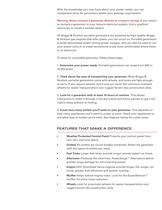
With the knowledge you now have about your power needs, you can comparison shop for generators within your wattage requirement. Warning: Never connect a generator directly to a homes wiring! Determine your power needs. Portable generators can range from 900 to 10,000 watts 2. If you intend to connect a generator to your homeҒs electrical system, hire a qualified electrician to install a transfer switch. All Briggs & Stratton portable generators are powered by high-quality Briggs & Stratton gas engines that offer power you can count on. Portable generators provide dependable power during power...
Open the catalog to page 2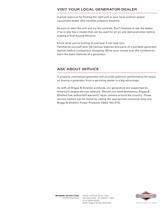
BRIGGS & STRATTON CORPORATIONPOST OFFICE BOX 702MILWAUKEE, WI 53201 USA414 259 5333 ҩ2007 Briggs & Stratton Corporation >
Open the catalog to page 3All BRIGGS and STRATTON catalogs and technical brochures
 Snow Blowers
3 Pages
 air compressor
4 Pages
 Pressure washers
4 Pages
 ENGINES
3 Pages

- Power generator
- Industrial genset
- Three-phase generator set
- Stationary genset
- 60 Hz generator set
- Single-phase generator set
- Mobile high-pressure cleaner
- 4-stroke engine
- Mechanical fuel injection generator set
- Portable generator set
- High-pressure cleaner with combustion engine
- Air cooling engine
- Gasoline engine generator set
- Gasoline engine
- Generator set on casters
- Single-cylinder engine
- Overhead valve engine