

Spray dry manual
1 /25Pages

Spray dry manual
1 /25Pages
Catalog excerpts
9 1.0 Introduction 2 1.1 Why dry? 2 1.2 Why Spray Dry? 6.1 Powder Shape 9 6.2 Powder Size 2 1.3 History of spray drying 9 6.3 Size distribution 2 1.4 Spray drying basics 9 6.4 Bulk density 2 1.4.1 Concentration 9 6.5 Factors affecting bulk density 2 1.4.2 Atomization 9 6.6 Agglomeration 2 1.4.3 Droplet-air contact 9-10 2 1.4.4 Droplet drying 3 1.4.5 Separation 7.0 Spray Dry Nozzle Selection 10 3 7.1 Replacing the Delavan SDX 10 7.2 Replacing Other Nozzles 10 7.3 Twist & Dry Software 2.0 Spray Dryer Types 3 10 2.1 Co-current flow 3 2.2 Counter-current flow 3 2.3 Mixed flow 8.0 Spray nozzle maintenance...
Open the catalog to page 2
1.4.3 Droplet-air contact The central element of a spray dryer is the spray dry chamber. In the chamber, atomized liquid is brought into contact with hot gas (usually air, at a vacuum), resulting in the evaporation of 95%+ of the water contained in the droplets in a matter of a few seconds. The way in which the spray makes contact with the air in the dryer influences the behavior of the droplet during the drying phase and has a direct bearing on the properties of the dried product. The type of contact between the spray and the air is determined by the position of the atomizer relative to 1.4...
Open the catalog to page 3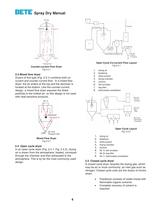
Open Cycle Co-current Flow Layout Counter-current Flow Dryer > Fig 2.4.1 Fig 2.2.1 3. > dried product 4. > drying chamber 5. > cyclone 6. > wet scrubber 7. > bag filter 8. > electrostatic precipitator Open Cycle Layout > Fig. 2.4.2 1. > drying air Mixed Flow Dryer 2. > feedstock Fig 2.3.1 3. > dried product 5. > cyclone 6. > Alt. A: wet scrubber 7. > Alt. B: bag filter 8. > Alt. C: electrostatic precipitator
Open the catalog to page 5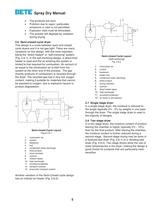
condensed water discharge > Figure 2.6.1 1. combustion air 2. coolant 3. feedstock 4. fuel 5. condensed waste discharge 6. dried product 7. dryer chamber 8. cyclone 9. indirect heater 10. heat exchanger 11. scrubber/condenser 12. transport cyclone 13. pneumatic transport system >
Open the catalog to page 6
Twist & Dry is capable of handling this entire pressure range. The TD-K should be used for pressures above 3500 PSI and up to 10,000 PSI. See the TD Material Selection Guide for the appropriate TD nozzle setup for your operating conditions. 3.4 Two-fluid nozzles Liquid feedstock and compressed air (or steam) are combined in a two-fluid nozzle. The design utilizes the energy of compressed gas to atomize the liquid. Two-fluid nozzles are able to atomize highly viscous feeds, but they are expensive to operate because of the high cost of compressed air. Two advantages of the two-fluid nozzle are...
Open the catalog to page 8
Nozzle Wizard software will calculate an estimated sauter mean diameter for any set of operating conditions. 4.10 Micron The unit of measurement used for particles. One micron equals one millionth of a meter, or 0.0000394 inches. 4.11 BETE Twist & Dry Droplet Size BETE has done extensive droplet size testing on the Twist & Dry in the BETE laboratory, spraying water. The Twist & Dry nozzle is capable of producing sprays with sauter mean diameters ranging from about 30 microns to 120 microns, depending on the pressure and flow rate. The BETE > 4.8 Sauter mean diameter (D32) 4.1 Droplet 4.2 Particle...
Open the catalog to page 9
6.5 Factors affecting bulk density 6.4 Bulk density Increasing feed rate increases bulk density if the residual moisture increases 6.3 Size distribution Օ If increasing feed temperature leads to the production of spherical droplets instead of threadsђ, bulk density increases. The size distribution of dried particles is generally narrower than the size distribution of atomized liquid particles. Rotary atomizers produce more uniform particle sizes compared to pressure atomizers. Bulk density is the weight of dried powder per unit volume. This is a critical factor for most spray drying operations...
Open the catalog to page 10
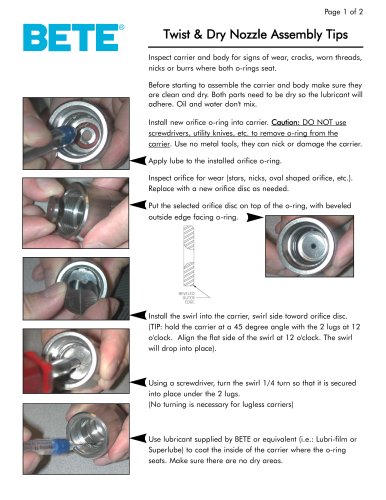
8.5 Body The velocity of feedstock through the internal passages of the body are much lower than the 8.4 Seals Leaking nozzles in a spray dryer can cause serious problems, including ruined product, fires and explosions. For this reason, it is critical to ensure that the nozzles will not leak during operation. Most Twist & Dry nozzles use o-rings as seals. Because of the high operating pressures and high temperatures of the spray dry chamber, BETE recommends that the o-rings be replaced each time that the nozzle is disassembled. BETE recommends the use of a USDA approved lubricant on all o-rings....
Open the catalog to page 11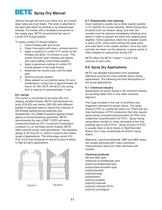
to aid in the removal of swirl units. > velocity through the swirl and orifice and, as a result, wear rates are much lower. The body is attached to the feed pipe either by welding or by tapered pipe threads. For bodies with a threaded connection to the supply pipe, BETE recommends the use of Loctite 272 thread sealant. To apply Loctite 272 thread sealant: Dryer operators usually use a dilute caustic solution (1-2% NaOH) for nozzle cleaning. When drying dairy products such as cheese, whey, and milk, the nozzles must be cleaned immediately following shut down in order to prevent the parts from...
Open the catalog to page 12
Soap and detergent products alky-aryl sulphonates detergent enzymes dispersing agents emulsifying agents fatty alcohol sulphate heavy-duty detergents light-duty detergents mono and dipotassium orthophosphate mono and disodium orthophosphate nitrilo tri-acetic acid salts optical brightener phosphates saponine sodium lauryl sulphate 9.3 Detergents, soaps and surface active agents The production of washing powders is one of the most common spray dry applications. Counter- current dryers with nozzle atomization are preferred for high-bulk-density detergents. Open-cycle dryers are most commonly used,...
Open the catalog to page 13
using rotary atomizers. Mineral and ore products Copper ore Cryolite Iron ore Lead ore Manganese ore Molybdenum ore Nickel ore Platinum ore Silver ore Tungsten ore 9.8 Inorganic chemicals Cement slurries are dried prior to calcining operations in spray dryers using either rotary atomizers or pressure nozzles. Spray drying is well established in the preparation of catalysts. Due to the great variation in catalyst requirements, rotary atomizers, pressure nozzles and two-fluid nozzles are used. Both rotary atomizers and pressure nozzles are used to spray dry sodium silicate (waterglass). Sodium...
Open the catalog to page 15All BETE catalogs and technical brochures
 WL metric
1 Page
 PJ metric
1 Page
 NF
NF1 Page
 TW metric
1 Page
 TW
TW1 Page
 AFF metric
1 Page
 TF10-170
1 Page
 TF24
TF241 Page
 TF FM Approved
1 Page
 TF metric
1 Page
 MaxiPass®
2 Pages
 HydroClaw®
2 Pages
 XAAD
XAAD1 Page
 ST
ST1 Page
 XA Components & Options
1 Page
 Engineering Information
9 Pages
 Custom In-House Fabrications
2 Pages
 BETE Spray Nozzle Catalog
134 Pages
 Line Card
2 Pages
 Bottle, Drum & Tank Washing
16 Pages
 BETE Metric Catalog
132 Pages
 LEM
LEM1 Page
 NFH
NFH1 Page
 BJH
BJH1 Page
 TurboMix
1 Page
 Twist & Dry
5 Pages
 TF29
TF291 Page
 N fire protection
1 Page
 AFF
AFF1 Page
 CLUMP
CLUMP1 Page
 HydroWhirl Orbitor
2 Pages
 HydroWhirl ® Poseidon
1 Page
 HydroWhirl S
1 Page
 SAM
SAM2 Pages
 XA Accessories
4 Pages
 XA
XA7 Pages
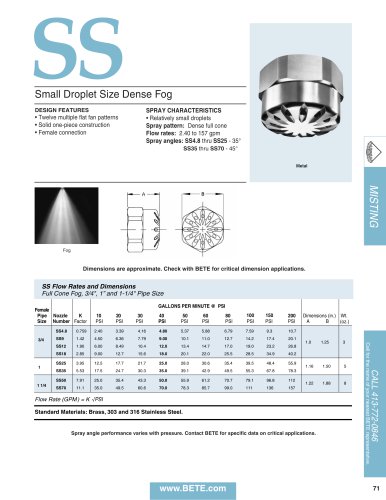 SS
SS1 Page
 UltiMist
1 Page
 L
L1 Page
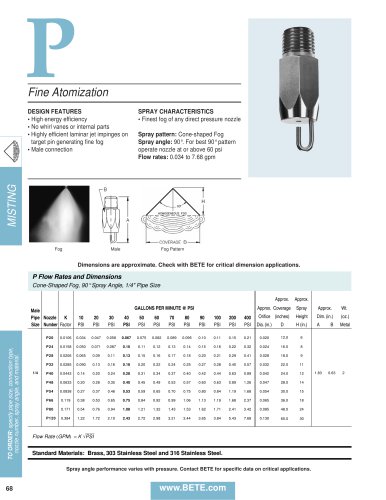 p
p1 Page
 PJ
PJ1 Page
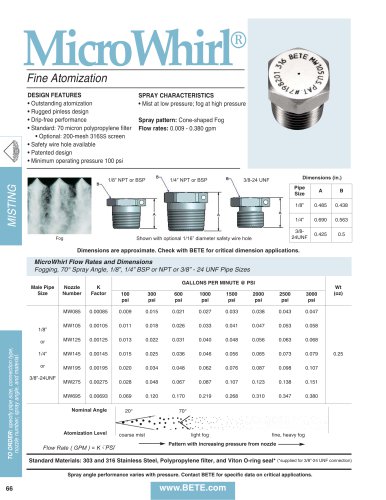 MicroWhirl
1 Page
 SPN
SPN1 Page
 EZ FF NF SPN
2 Pages
 FF
FF2 Pages
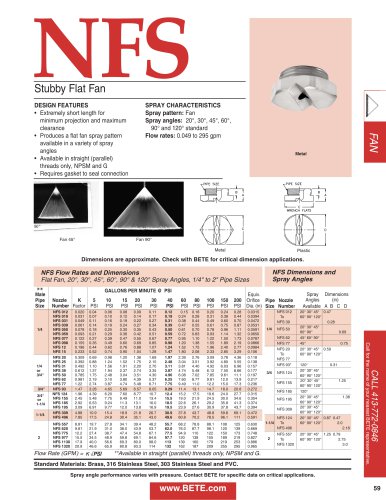 nfs
nfs1 Page
 NFD
NFD1 Page
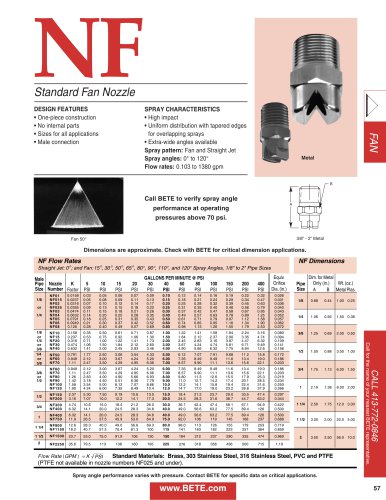 NF
NF1 Page
 NFV
NFV1 Page
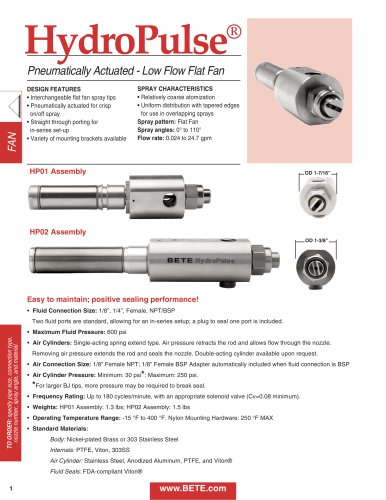 HydroPulse
4 Pages
 BJ
BJ2 Pages
 Spillback
2 Pages
 THW
THW2 Pages
 NCJ
NCJ1 Page
 TH
TH2 Pages
 WTX
WTX2 Pages
 WT
WT2 Pages
 TC
TC1 Page
 NCFL
NCFL1 Page
 NCK
NCK1 Page
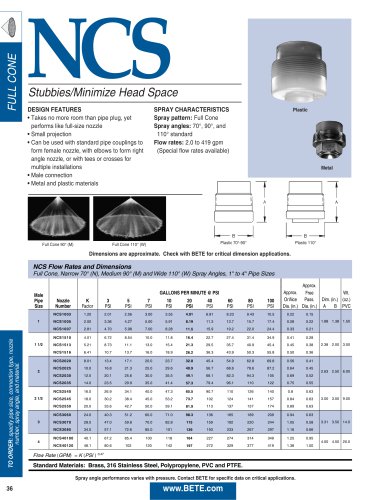 NCS
NCS1 Page
 NC
NC2 Pages
 SF
SF3 Pages
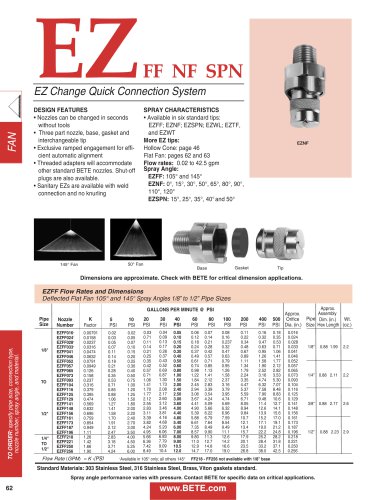 EZFF
EZFF2 Pages
 WTZ
WTZ1 Page
 CW
CW2 Pages
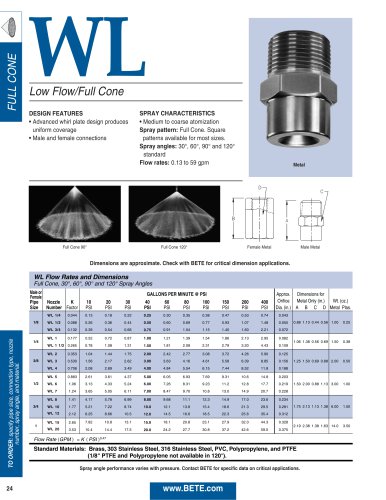 WL
WL1 Page
 STXP
STXP1 Page
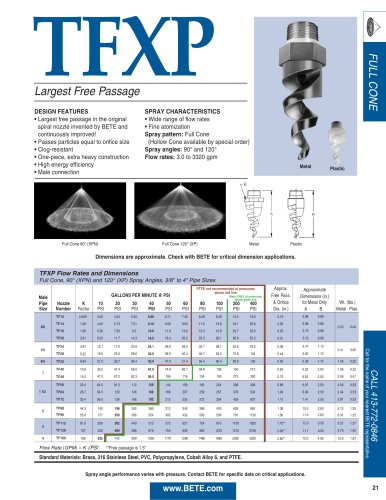 TFXP
TFXP1 Page
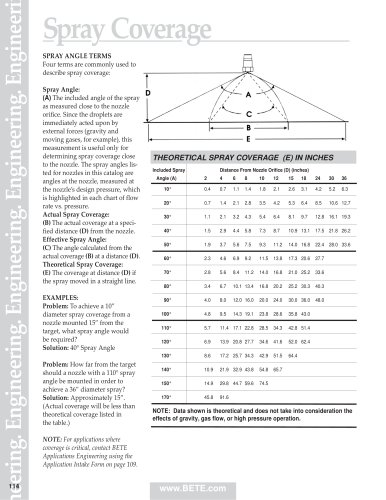 Spray Coverage
1 Page
 Bete accessories
1 Page
 MATERIALS
1 Page
 Custom Lance Intake Sheet
2 Pages
 Pollution Control
8 Pages
 Food Industry
8 Pages
 Fire Protection
8 Pages
 DUR O LOK®
6 Pages
 Chemical Processing
8 Pages
 Spray Nozzle Catalogs
127 Pages
 MaxiPass ® L
1 Page
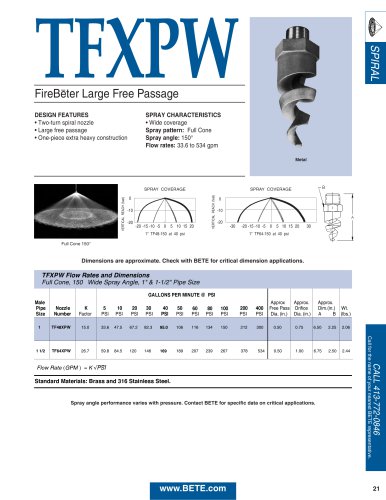 TFXPW
TFXPW1 Page
 N
N2 Pages
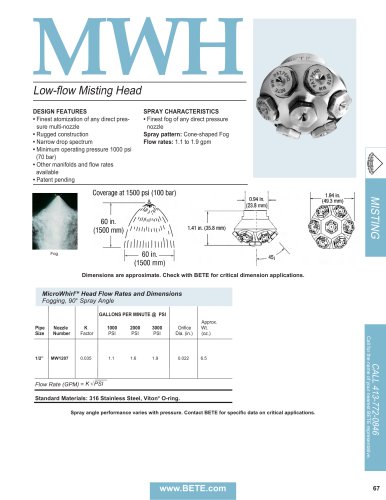 MicroWhirlTM Head (MWH)
1 Page
 MaxiPassTM (MP)
2 Pages
 LP
LP1 Page
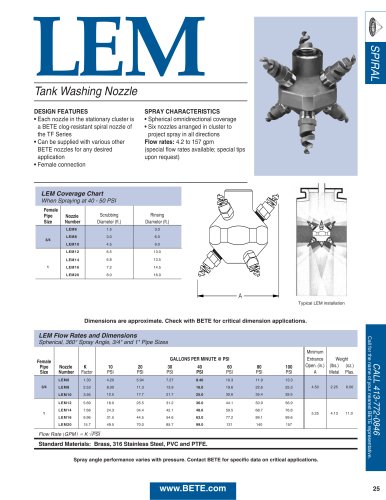 LEM
LEM1 Page
 IS
IS1 Page
 FluidBed
1 Page
 Spray Drying
11 Pages
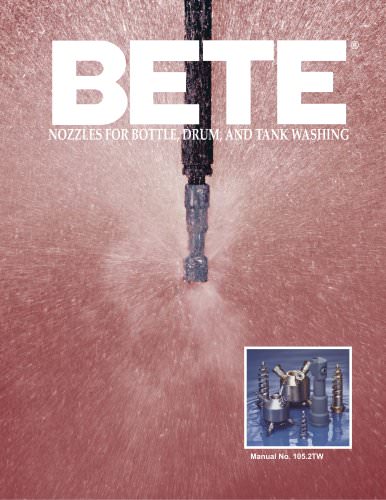 Bottle, Drum & Tank Washing
16 Pages
 TD/TD-K
4 Pages
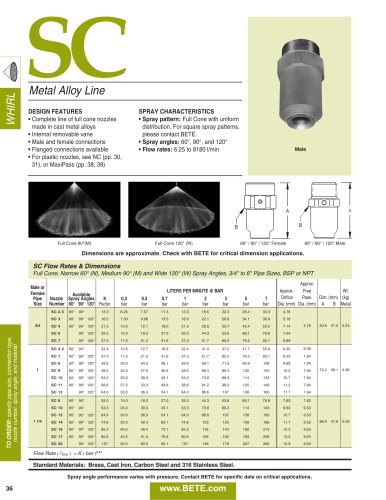 SC
SC2 Pages
 FINZTM
1 Page


Archived catalogs
 SpiralAir
2 Pages
 SpiralAirTM
2 Pages
 TF_2021
1 Page
 TF
TF1 Page
 TW
TW1 Page
 N Fire Protection
2 Pages
- Liquid nozzle
- Stainless steel nozzle
- Cleaning nozzle
- Multi-jet nozzle
- Air nozzle
- Screw-in single nozzle
- Cooling nozzle
- Industrial tip
- Flat spray tip
- Brass atomizing nozzle
- Plastic nozzle
- Nozzle for the chemical industry
- Full-cone nozzle
- Nozzle for the food industry
- Nozzle for the steel industry
- Water nozzle
- 90° atomizing nozzle
- Washing nozzle
- Compact nozzle