
- Catalogs
- ASAHI Diamond
- Diamond & CBN Srinding wheels

Diamond & CBN Srinding wheels
1 /22Pages

Diamond & CBN Srinding wheels
1 /22Pages
Catalog excerpts
Grinding Asahi Diamond Industrial Co., Ltd. has been chasing this theme. Grinding is an indispensable step of the manufacturing process. Asahi manufactures a comprehensive array of “superabrasive wheels” using the highest quality diamond and CBN (Cubic Boron Nitride). Superabrasive wheels play a key role in the grinding process for electric, semiconductor, automotive, bearing, and mold making industries. Asahi Diamond aims, through research and development, to manufacture wheels which have characteristics such as “faster cutting speeds,” “extremely accurate,” and are “safe and clean” in order...
Open the catalog to page 2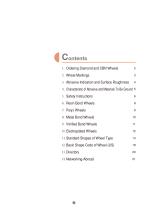
3. Abrasive Indication and Surface Roughness - "4 4. Characteristic of Abrasive and Materials To Be Ground 5
Open the catalog to page 3
Ordering Diamond and CBN Wheels Please indicate the following when placing a new order. 1.Materials to be ground (What type of product do you produce?) (1) Name : (2) Material : (3) Hardness : (4) Size : (5) Stock removal : (6) Required Surface Roughness : (7) Required Accuracy Tolerances: 2.Machine Type (What kind of machine do you use?) (1) Type and Model: (2) Spindle Capacity: (3) Type of Grinding(Surface Grinding, Cylindrical Grinding etc.) : (4) Wheel Revolution: (5) Peripheral Speed: (6) Feed Rate: (7) Depth of Cut: (8) Coolant Type: (9) Other Conditions: 3.Wheel Being Used (What kind of...
Open the catalog to page 4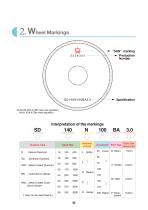
Wheel Markings “SUN” marking Production Number SD140N100BA3.0 JIS B4130 (DIA & CBN mesh size regulation) B4131 (DIA & CBN wheel regulation) Mesh Size Abrasive Type : Natural Diamond : Synthetic Diamond SDC : Metal Coated Diamond BN : Cubic Boron Nitride* BNC : Metal Coated Cubic Boron Nitride* (* Also can be described B.) Concentration Bond Type 25 Lower 3.0 Depth of Super Abrasive Section
Open the catalog to page 5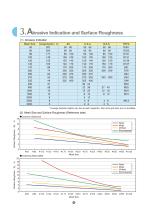
rasive Indication and Surface Roughness "Average diameter slightly vary due to each regulation. Also some grit sizes are not available. (2) Mesh Size and Surface Roughness (Reference date) ♦Ceramics (Diamond) Mesh Size Mesh Size
Open the catalog to page 6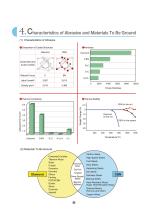
haracteristics of Abrasive and Materials To Be Ground ©Comparison of Crystal Structures Crystal Structure (Cubic Crystal) Molecular Formula Knoop Hardness ©Thermal Conductivity ©Thermal Stability Cemented Carbide Titanium Alloys Carbon steels High-Speed Steels Tool Steels Alloy Steels Hardening Steels Stainless Steels Bearing Steels Heat-Resistant Alloys/ Super Heat-Resistant Alloys, Sintered Metals Copper Alloys
Open the catalog to page 7
Safety Instructions For preventing accidents and safe operation, carefully read the Safety Instructions, the notes described in Inspection List and the Operators Manual before operating. (1) Working Environment, Clothes, Protections Operators should put on protection such as goggles, dustproof mask, safety boots, protecting cap. Wheels can generate sparks during operation. Do not operate where subjected to ignition or explosion. (2) Prior to Operation Make sure to apply grinding fluid continuesly when using in wet grinding. Do not reprofile the wheel, please return to us. Do not operate when...
Open the catalog to page 8
(4) Grinding Operation Do not touch spinning wheel. In case of dry grinding, do not touch wheel even after grinding because it might be hot. Never operate exceeding the maximum operating speed designated in Wheel Inspection List as well as tolerance operating speed of grinder spindle. When unusual sound or vibration occurs, stop the operation and switch off the machine immediately. Make a no-load trial run for 1 to 3 minutes prior to operation in order to make sure the operating direction is correct and there is no vibration. When processing wet, be sure to apply grinding fluid sufficiently at...
Open the catalog to page 9
Resin Bond Wheels Resin bond is usually made with heat-cured resin mainly composed of phenolic resin. Resin bond wheel has excellent grinding ability, surface finish and minimal chipping. It is widely applied for difficult-to-machine materials such as cemented carbide, ceramics, glass, and silicon as well as ferrous materials such as high-speed steels and sintered ferrous metals. (1) Characteristics of Resin Bond Wheels Resin bond usually has some added filler such as organic and inorganic materials, metals, etc. into the phenolic resin in order to control its wear resistance, heat resistance,...
Open the catalog to page 10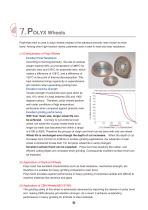
POLYX Wheels Polyimide resin is used in polyx wheels instead of the standard phenolic resin known as resin bond. Among other high-function resins, polyimide resin is best in heat and wear resistance. (1) Characteristics of Polyx Wheels The Rate of Residual Weight (%) Excellent Heat Resistance According to thermogravimetry, the rate of residual weight reaches 90% at a temperature of 388°C for phenolic resin and 516°C for polyimide resin, which makes a difference of 128°C, and a difference of 150°C at the point of thermal decomposition. This heat resistance brings superiority in superabrasive grit...
Open the catalog to page 11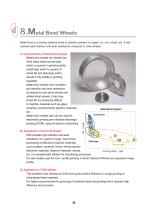
Metal Bond Wheels Metal bond is a binding material made of metallic powders of copper, tin, iron, cobalt, etc. It has excellent grit retention and wear resistance compared to other wheels. Metal Bond System Cobalt-type (1) Characteristics of Metal Bond Wheels Metal bond wheels are divided into three major types bronze-type which is superior in grinding ability cobalt-type which is superior in wheel life and steel-type which stands in the middle in grinding capability. Metal bond wheels have excellent grit retention and wear resistance compared to resin bond wheels and vitrified bond wheels, it...
Open the catalog to page 12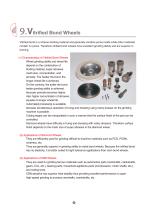
Vitrified Bond Wheels Vitrified bond is a vitreous binding material and generally contains pores inside while other materials contain no pores. Therefore vitrified bond wheels have excellent grinding ability and are superior in forming. (1) Characteristics of Vitrified Bond Wheels Wheel grinding ability and wheel life depend on the combination of binding material, super abrasive mesh size, concentration, and porosity. The harder the bond, the longer wheel life is achieved. On the contrary, the softer the bond, better grinding ability is achieved because porosity becomes higher. Also higher concentration...
Open the catalog to page 13All ASAHI Diamond catalogs and technical brochures
 Prisma Dressers
3 Pages
 Diamond dies
14 Pages
 Diamond roller dressers
16 Pages
 Product catalog
40 Pages
 Multi-edged PCBN inserts
4 Pages
 Cutting&Wear Resistant Tools
9 Pages
 Diamond & CBN wheels
22 Pages
 Diamond Dressers
20 Pages
 Precision Cutting Tools
18 Pages
 Diamond machining tools
15 Pages
 Diamond Dies
5 Pages
 Polycrystalline diamond dressers
3 Pages


- Milling tool
- Solid milling cutter
- Drilling tool
- Steel milling cutter
- Solid drill bit
- Metal milling cutter
- Clamping milling cutter
- Saw blade
- Liquid nozzle
- Milling cutter with cylindrical shank
- Grade
- Stainless steel nozzle
- Face milling cutter
- Multi-purpose drilling tool
- Cleaning nozzle
- Sanding disc
- Circular saw blade
- Metal saw blade
- Surface treatment wheel
- Cut-off disc