
- Catalogs
- APLISENS S.A.
- Level transmitters

- Company
- Products
- Catalogs
- News & Trends
- Exhibitions
Level transmitters
1 /12Pages

Level transmitters
1 /12Pages
Catalog excerpts

CapillaryRed (+)Black ()Lifting handleDiaphragm level The SGE-25 hydrostatic level probe is applicable to meas-ure liquid levels in tanks, deep wells or piezometers. The SGE-16 probe is a specialized device designed to measure water levels in narrow diameter piezometers or wells. > The probe measures liquid levels, basing on a simple relationship between the height of the liquid column and the resulting hydrostatic pressure. The pressure meas-urement is carried out on the level of the separating dia-phragm of the immersed probe and is related to atmos-pheric pressure through a capillary in the cable. The active sensing element is a piezoresistant silicon sensor separated from the medium by an isolating dia-phragm. The electronic amplifier, which works in combina-tion with the sensor, and is meant to standardize the sig-nal, is additionally equipped with an overvoltage protection circuit, which protects the probe from damage caused by induced interference from atmospheric discharges or from associated heavy current engineering appliances. > When lowered to the reference level, the probe may either hang freely on the cable or lie on the bottom of the tank. The cable with the capillary can be extended using a stan-dard signal cable. For the cable connection a special Ap-lisens > 170 SG cable hanger is recommended. The cable con-nection should be situated in a non-hermetically sealed box (the internal pressure inside the box should be equal to the atmospheric pressure), preventing water or other contaminants from getting into the capillary. The Aplisens > 140 PP junction box is recommended For systems with long signal transmission lines, it is recommended the using of an additional Aplisens UZ-2 overvoltage protection circuit in the form of a wall-mounted box which allows the cables connection. When the probe cable is being wound up, the minimum winding diameter should be 30cm and the cable should be protected from mechanical damage. If there is a possibility > of turbulence in the tank (for exam-ple, because of the mixer operating mixers or a turbulent inflow), the probe should be installed inside a screening tube (e.g. made of PVC). If the probe is to be lowered deeper than 100m, the cable should be hanged at steel lifting rope. Cleaning the probe diaphragm by mechanical means is strictly prohibited. >
Open the catalog to page 1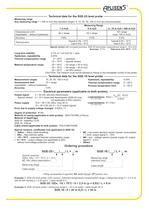
Measuring range Any measuring range 1 500 m H > 2 O (the standard ranges: 4, 10, 20, 50, 100 m H > 2 O are recommended) Measuring Range 1 m H > 2 O 4 m H > 2 O 0...10 m H > 2 O 500 m H > 2 O Overpressure Limit (repeatable 緖 without hysteresis) 40 range 25 ח range 10 range (max. 700 m H > 2 O) Accuracy 0.6% 0.3% 0.2% Thermal error Typical 0.3% / 10װC max 0.4% / 10C Typical 0.2% / 10аC max 0.3% / 10C > Special version with increased accuracy: SGE-25 level probe, measurement range 0...10 m H 2 O Accuracy 0.1%; Total error at 0...25аC 0.3% Long term stability 0.1% or 1 cm H > 2 O for 1 year Hysteresis,...
Open the catalog to page 2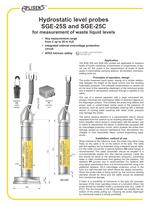
The SGE-25S and SGE-25C probes are applicable to measure levels of liquids containing contaminants or suspensions. A typi-cal use for this probe is the measurement of levels of liquid waste in intermediate pumping stations, fermentation chambers, settling tanks etc. > CapillaryRed (+)Black () The probe measures liquid levels, basing on a simple relation-ship between the height of the liquid column and the resulting hydrostatic pressure. The pressure measurement is carried out on the level of the separating diaphragm of the immersed probe and is related to atmospheric pressure through a capillary...
Open the catalog to page 3
Any measurement range 2 20 m H > 2 O (we recommend the standard ranges: 2, 4, 10 m H > 2 O) Measuring Range 2 m H > 2 O 4 m H > 2 O 0...10 m H > 2 O 20 m H > 2 O Overpressure Limit (repeatable 緖 without hysteresis) 20 range 20 ח range 10 range Accuracy 1.5% 1% 0.5% Thermal error of zero Typical 0.4% / 10װC max 0.6% / 10C Typical 0.2% / 10аC max 0.3% / 10C Thermal error of span Typical 0.3% / 10аC max 0.4% / 10C Typical 0.2% / 10аC max 0.3% / 10C Hysteresis, repeatability 0.05% Thermal compensation range 0 з 25C Medium temperature range -25 з 75C -25 з 50C Ж for EEx version / only SGE-25S/ CAUTION:...
Open the catalog to page 4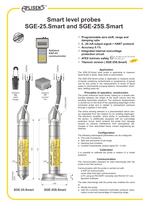
NEW CapillaryRed (+)Black () CapillaryRed (+)Black (֖) The SGE-25.Smart level probe is applicable to measure liquid levels in tanks, deep wells or piezometers. The SGE-25S.Smart probe is applicable to measure levels of liquids containing contaminants or suspensions. A typical use for this probe is the measurement of levels of liquid waste in intermediate pumping stations, fermentation cham-bers, settling tanks etc. > Aplisens Aplisens SG cable hanger PP junction box The probe measures liquid levels, basing on a simple rela-tionship between the height of the liquid column and the resulting hydrostatic...
Open the catalog to page 5
When lowered to the reference level, the probe may either hang freely on the cable or lie on the bottom of the tank. The cable with the capillary can be extended using a stan-dard signal cable. For the cable connection a special Ap-lisens tional Aplisens UZ-2 overvoltage protection circuit in the form of a wall-mounted box which allows the cables connec-tion. When the probe cable is being wound up, the minimum winding diameter should be 30cm and the cable should be protected from mechanical damage. If there is a possibility of turbulence in SG cable hanger is recommended. The cable con-nection...
Open the catalog to page 6
Blue BlackBlack The SG.Profibus PA-25 smart level probe is applicable to measure liquid levels in tanks, deep wells and in inter-mediate pumping stations, fermentation chambers, set-tling tanks etc. > The probe measures liquid levels, basing on a simple relationship between the height of the liquid column and the resulting hydrostatic pressure. The pressure meas-urement is carried out on the level of the separating diaphragm of the immersed probe and is related to at-mospheric pressure through a capillary in the cable. The active sensing element is a piezoresistant silicon sensor separated from...
Open the catalog to page 7All APLISENS S.A. catalogs and technical brochures
 2022-2023 PRODUCT CATALOGUE
180 Pages
 2019-2020 PRODUCT CATALOGUE
176 Pages
 Product catalog 2017
166 Pages
 PRODUCT CATALOGUE 2016/2017
168 Pages
 PRODUCT OVERVIEW
6 Pages


Archived catalogs
 APLISENS CATALOGUE 2015/2016
156 Pages
 APC-2000ALW
5 Pages


- Valve
- Manual valve
- Power supply unit
- Flowmeter
- Stainless valve
- DC power supply
- AC/DC power supply
- Ball valve
- Volume flow monitor
- Liquid flow monitor
- Temperature probe
- Data logger
- Lever valve
- Pressure transmitter
- Resistance temperature sensor
- Level limit switch
- Pressure gauge
- Analog pressure transmitter
- Waterproof flow meter
- Liquid level detector