
 Website:
ANSYS
Website:
ANSYS
Group: ANSYS


Catalog excerpts

The broad physical modeling capabilities of FLUENT software have been applied toindustrial applications ranging from air flow over an aircraft wing to combustion in a furnace, from bubble columns to glass production, from blood flow to semiconductor manufacturing, from clean room design to wastewater treatment plants. The ability of the software to model in-cylinder engines, aeroacoustics, turbomachinery and multiphase systems has served to broaden its reach. Today, thousands of companies throughout the world benefit from this important engineering design and analysis tool. Its extensive range of multiphysics capabilities makes it the most comprehensive fluids simulation software available to the engineering analysis community.With its long-standing reputation of being user-friendly and robust, FLUENT softwaremakes it easy for new users to come up to productive speed. In conjunction with this, ANSYS technical support offers comprehensive user training focused on making customers successful. Throughout the years, these important components Η compre- hensive models, usability and technical support have combined to accelerate the adoption of FLUENT fluid dynamics software across a broad spectrum of industries worldwide. > Vortex structures generated by an aircraft landing gear At the core of any computational fluid dynamics calculation is a computational grid, which is used to divide the solution domain into thousands, or millions, of elements in which the problem variables are computed and stored. In FLUENT software, unstruc- tured grid technology is used; this means that the grid can consist of elements in a vari- ety of shapes, such as quadrilaterals and triangles for 2-D simulations and hexahedra, tetrahedra, polyhedra, prisms and pyramids for 3-D simulations. These elements form an interlocking network throughout the volume where the fluid flow analysis takes place. Meshes can be created using automated controls in GAMBIT > software (thecompanion pre-processor for FLUENT) using other ANSYS or third-party meshing products and, in the case of polyhedra, via automatic cell agglomeration directly within FLUENT software. In the commercial analysis arena, FLUENT technology is a leader in the number ofcomplex physical models offered on an unstructured grid. Sophisticated numerics and robust solvers ― including a pressure-based coupled solver, a fully-segregated pres- sure-based solver and two density-based solver formulations ― help ensure accurate results for a nearly limitless range of flows. Mature parallel processing capabilities, available on Windows > Polyhedral mesh and pressure distributionon an F1 car Pressure contours on a stator and rotor in a down-hole turbine , Linux > ή and UNIX > platforms, can be used on multiple proces-sors of a single machine or multiple machines on a network. Dynamic load balancing >
Open the catalog to page 1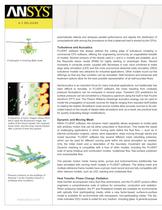
6.3 RELEASE automatically detects and analyzes parallel performance and adjusts the distribution ofcomputational cells among the processors so that a balanced load is shared by the CPUs. ε and k ֏ models are available, as isthe Reynolds stress model (RSM) for highly swirling or anisotropic flows. Recent increases in computer power, coupled with decreases in cost, have combined to make large eddy simulation (LES) and the more economical detached eddy simulation (DES) turbulence models very attractive for industrial applications. Other models round out the offerings so that any flow condition...
Open the catalog to page 2
discrete transfer radiation model is also available. A solar load model makes use of a ray-tracing algorithm and includes a solar calculator. It allows for visualization of illumi- nated and shadowed areas, making climate control simulation results meaningful.Other capabilities closely associated with heat transfer include models for cavitation,compressible liquids, heat exchangers, shell conduction, real gas and wet steam. The phase change model tracks melting and freezing in the bulk fluid. Evaporation from droplets or wet particles and devolatilization from coal are available with the...
Open the catalog to page 3All ANSYS catalogs and technical brochures
-
 Ansys SpaceClaim Direct
2 Pages
-
 Ansys SCADE Display
5 Pages
-
 Ansys SCADE Test
4 Pages
-
 ANSYS HFSS
2 Pages
-
 ANSYS AIM
2 Pages
-
 Discovery
2 Pages
-
 ANSYS Twin Builder
1 Pages
-
 ANSYS VRXPERIENCE
4 Pages
-
 ANSYS® Simplorer® 17
5 Pages
-
 ANSYS Licensing on the Cloud
8 Pages
-
 ANSYS SpaceClaim
2 Pages
-
 ANSYS AIM
2 Pages
-
 ANSYS FENSAP-ICE TURBO
8 Pages
-
 ANSYS FENSAP-ICE
4 Pages
-
 turbomachinery
4 Pages
-
 ANSYS Forte
4 Pages
-
 ANSYS Model Fuel Library
2 Pages
-
 Chemkin-Pro
6 Pages
-
 Polyflow
8 Pages
-
 ANSYS® SCADE LifeCycle® 17.0
2 Pages
-
 ANSYS® SCADE Suite® 17.0
7 Pages
-
 ANSYS® SCADE System® 17.0
6 Pages
-
 ANSYS SIwave
2 Pages
-
 ANSYS Maxwell
2 Pages
-
 ANSYS DesignXplorer
8 Pages
-
 ANSYS SpaceClaim
2 Pages
-
 Hybrid Electric Powertrain
2 Pages
-
 Meshing Solutions
4 Pages
-
 High-Performance Computing
8 Pages
-
 ANSYS Structural
2 Pages
-
 SCADE System ® R16
5 Pages
-
 ANSYS Q3D Extractor
2 Pages
-
 ansys-icepak-brochure
8 Pages
-
 EMIT
EMIT5 Pages
-
 ANSYS 17.0 Capabilities
19 Pages
-
 Explicit Dynamics
8 Pages
-
 Fluid Dynamics
8 Pages
-
 Electromagnetics
12 Pages
-
 ANSYS Meshing Solutions
4 Pages
-
 Ansys brochure
12 Pages
-
 SIwave
12 Pages
-
 Q3D Extractor
8 Pages
-
 Fatigue Products
8 Pages
-
 Icepak
8 Pages
-
 TGrid
TGrid4 Pages
-
 ANSYS Workbench Platform
4 Pages
-
 SCADE LifeCycle
3 Pages
-
 SCADE Suite
5 Pages
-
 SCADE System
3 Pages
-
 ANSYS Simplorer
8 Pages
-
 Systems & Multiphysics Solutions
12 Pages
-
 ANSYS Mechanical Products
12 Pages
-
 ANSYS Vista TF
2 Pages
-
 ANSYS AQWA
4 Pages
-
 ansys-fluent-brochure
12 Pages
-
 ansys-maxwell-brochure
8 Pages
-
 ansys-hfss-brochure
12 Pages
-
 ansys-cfx-brochure
4 Pages
-
 ANSYS Composite PrepPost
2 Pages
-
 ANSYS ASAS
4 Pages
-
 FLUENT® for CATIA® V5
4 Pages


Archived catalogs
-
 ANSYS® SCADE Display® 17.0
6 Pages
-
 ANSYS® SCADE Test™ 17.0
4 Pages
-
 SCADE Display
4 Pages
