


ANSYS AQWA
1 /4Pages

ANSYS AQWA
1 /4Pages
Catalog excerpts
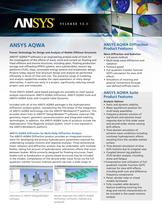
ANSYS AQWA ANSYS AQWA Diffraction Product Features Proven Technology for Design and Analysis of Mobile Offshore Structures ANSYS® AQWA™ software is an engineering analysis suite of tools for the investigation of the effects of wave, wind and current on floating and fixed offshore and marine structures, including spars, floating production storage and offloading (FPSO) systems, semi-submersibles, tension leg platforms (TLPs), ships, renewable energy systems and breakwater design. Projects today require that structure design and analysis be performed efficiently in terms of time and cost. The powerful range of modeling and analysis capabilities enables the rapid assessment of many design alternatives, in particular early in a project, significantly reducing overall project costs and timescales. Wave Diffraction and Radiation • 3-D panel method • Multi-body wave diffraction and radiation • Forward speed • Full quadratic transfer function (QTF) calculation for slow drift effects • Simulation of mooring and physical connections through user-defined stiffness matrix Three ANSYS AQWA value-based packages are available to meet typical analysis requirements: ANSYS AQWA Diffraction, ANSYS AQWA Suite and ANSYS AQWA Suite with Coupled Cable Dynamics. ANSYS AQWA Suite Product Features Included with all of the ANSYS AQWA packages is the Hydrodynamic Diffraction analysis system, representing the first phase of the integration of ANSYS AQWA technology into the ANSYS® Workbench™ platform. This provides direct links to ANSYS® DesignModeler™ software, external CAD geometry import, geometric parameterization and integrated meshing technologies. In addition, the ANSYS AQWA Suite of products include the Hydrodynamic Time Response analysis system, which is now exposed in the ANSYS Workbench platform. ANSYS AQWA Diffraction for Multi-body Diffraction Analysis The ANSYS AQWA Diffraction product provides an integrated environment for developing the primary hydrodynamic parameters required for undertaking complex motions and response analyses. Three-dimensional linear radiation and diffraction analysis may be undertaken with multiple bodies, taking full account of hydrodynamic interaction effects that occur between bodies. While primarily designed for floating structures, fixed bodies such as breakwaters or gravity-based structures may be included in the models. Computation of the second-order wave forces via the full quadratic transfer function matrices permits use over a wide range of Geometry in ANSYS DesignModeler software Model imported into ANSYS AQWA Diffraction software, meshed and analyzed Analysis Options • Static and dynamic stability • Mean equilibrium position for multi-body assemblies • Frequency-domain solution of significant and extreme linear response due to first-order wave and second-order, slowly varying drift effects • Time-domain simulation of extreme wave conditions including nonlinear hydrodynamic effects resulting from the variable wetted surface • Time domain simulation of slow drift motions due to irregular seas • Coupled tension leg platform (TLP) tendon analysis, including stress and fatigue • Computation and utilization of full quadratic transfer function (QTF) matrices for slow drift effects, including both sum and difference frequency components • Panel, slender tube or mixed models facilitated • Fully coupled cable dynamic feature enabling mooring line drag and inertial characteristics to be included in the vessel motions analysis
Open the catalog to page 1
ANSYS AQWA Suite Product Features Environmental Loading • Constant wind and current • Regular and irregular (spectral) waves • Wave surface time history • Wind time history • Current profile • Wind spectrum Mooring Capabilities • Linear elastic lines • Intermediate pulleys • Linear drum winches • General nonlinear polynomial • Multi-segment composite catenary • Nonlinear composite catenary • Thrusters • Constant force lines • Fixed or floating fenders • Intermediate buoys and clump weights • Line break facility • Quasi-static or dynamic catenaries Articulations • Physical connections between...
Open the catalog to page 2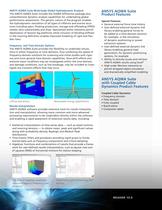
ANSYS AQWA Suite Multi-body Global Hydrodynamic Analysis The ANSYS AQWA Suite includes the AQWA Diffraction package plus comprehensive dynamic analysis capabilities for undertaking global performance assessments. The generic nature of the program enables the hydrodynamic simulation of all types of offshore and marine structures including spars; floating production, storage and offloading (FPSO) vessels; semi-submersibles and ships. Specialized tether elements permit idealization of tension leg platforms while inclusion of bending stiffness in the mooring definition enables improved modeling of...
Open the catalog to page 3
ANSYS AQWA Product General Capabilities Modeling • ANSYS Workbench interface providing access to import of geometries from ANSYS DesignModeler software or external CAD systems • Integrated meshing • Automatic generation of ship models from line plans (offsets) • Interface to ANSYS structural mechanics products via ANSYS Mechanical APDL command utility to export ANSYS AQWA data from ANSYS geometric models • Pressure and inertial load mapping to ANSYS Mechanical and ANSYS ASAS simulation products Visualization • Model display for mesh checking including zoom, pan, rotation controls together with...
Open the catalog to page 4All ANSYS catalogs and technical brochures
 Explicit Dynamics
8 Pages
 Ansys SpaceClaim Direct
2 Pages
 Ansys SCADE Display
5 Pages
 Ansys SCADE Test
4 Pages
 ANSYS Twin Builder
1 Page
 ANSYS VRXPERIENCE
4 Pages
 ANSYS® Simplorer® 17
5 Pages
 ANSYS FENSAP-ICE TURBO
8 Pages
 ANSYS FENSAP-ICE
4 Pages
 ANSYS Forte
4 Pages
 ANSYS Model Fuel Library
2 Pages
 Chemkin-Pro
6 Pages
 Polyflow
8 Pages
 ANSYS® SCADE LifeCycle® 17.0
2 Pages
 ANSYS® SCADE Suite® 17.0
7 Pages
 ANSYS Maxwell
2 Pages
 ANSYS DesignXplorer
8 Pages
 Meshing Solutions
4 Pages
 ANSYS Q3D Extractor
2 Pages
 ansys-icepak-brochure
8 Pages

Archived catalogs
 SCADE System ® R16
5 Pages
 ANSYS Structural
2 Pages
 High-Performance Computing
8 Pages
 Hybrid Electric Powertrain
2 Pages
 ANSYS SpaceClaim
2 Pages
 ANSYS SIwave
2 Pages
 ANSYS® SCADE System® 17.0
6 Pages
 turbomachinery
4 Pages
 ANSYS AIM
2 Pages
 ANSYS SpaceClaim
2 Pages
 Discovery
2 Pages
 ANSYS AIM
2 Pages
 ANSYS HFSS
2 Pages
 EMIT
EMIT5 Pages
 Fluid Dynamics
8 Pages
 ANSYS 17.0 Capabilities
19 Pages
 Electromagnetics
12 Pages
 ANSYS Meshing Solutions
4 Pages
 Ansys brochure
12 Pages
 SIwave
12 Pages
 Q3D Extractor
8 Pages
 Fatigue Products
8 Pages
 Icepak
8 Pages
 TGrid
TGrid4 Pages
 ANSYS Workbench Platform
4 Pages
 SCADE LifeCycle
3 Pages
 SCADE Suite
5 Pages
 SCADE System
3 Pages
 ANSYS Simplorer
8 Pages
 Systems & Multiphysics Solutions
12 Pages
 ANSYS Mechanical Products
12 Pages
 ANSYS Vista TF
2 Pages
 ansys-fluent-brochure
12 Pages
 ansys-maxwell-brochure
8 Pages
 ansys-hfss-brochure
12 Pages
 ansys-cfx-brochure
4 Pages
 ANSYS Composite PrepPost
2 Pages
 ANSYS ASAS
4 Pages
 FLUENT® for CATIA® V5
4 Pages
 SCADE Display
4 Pages
 ANSYS® SCADE Display® 17.0
6 Pages
 ANSYS® SCADE Test™ 17.0
4 Pages


- ANSYS automation software
- ANSYS management software
- ANSYS analysis software
- ANSYS process software
- Real-time software
- ANSYS CAD software
- Cloud-based software
- ANSYS control software
- ANSYS design software
- Monitoring software solution
- ANSYS 3D software
- ANSYS industrial software
- Interface software
- Measurement software
- ANSYS quality software
- Visualization software solution
- ANSYS simulation software
- ANSYS automated software
- ANSYS development software
- Network software