Catalogue 4TRESS Authentication SDK Strong authentication engine for enabling secure remote banking
www.actividentity.com/en
print switch display
Page / 2
Manufacturer's
contact details
Where to buy
this product ?
Request
a Quote
Actividentity -
/ 2
See other catalogues for Actividentity
Text version of the page
Data Sheet
Actividentity
Activldentity
4 TR ESSAuthentication SDK
Secure customer authentication
middle attacks and enabling non-repudiation for high-value funds transfer.
Secure multi-channel access
• Authentication engine available on major environments (from Microsoft® Windows® to Unix® and MVS), for easy integration into the organizations environment.
• Same authentication process can be easily integrated into multiple applications, such as web sites or phone application.
Large choice of authentication methods
• Offers authentication services with hardware tokens (with or without keypad), smart cards, USB tokens, mobile phones or PDAs.
• One-time password authentication based on patented three-variable algorithm— time, event counter and cryptographic key.
• Complies with strong authentication standards such as OATH (Open AuTHentication initiative) HOTP— capability to support EMV via extensions.
Device lifecycle management
• Manages the lifecycle of authentication devices, including personalization, initialization and maintenance.
Strong authentication engine for enabling
secure remote banking
The 4TRESS Authentication SDK is a highly scalable strong authentication engine designed to secure remote services, web access and e-business applications for bank and enterprise infrastructures. Based on industry standards, it allows banks to improve customer confidence while reducing major losses due to fraud.
Key features
Secure remote banking
• Offers two-factor authentication, based on "something you have" (an authentication device) and "something you know" (a PIN).
• Allows financial institutions and organizations to securely identify and authenticate customers remotely from anywhere in the world.
• Allows online users to validate the identity of the web site they connect to, preventing "phishing" attacks.
• Allows bank customers to sign transactions, preventing man-in-the-
Prevent phishing attacks by validating the identity of websites users visit
Benefits
Highly scalable
Modular design allows banks to meet the demand of millions of online users.
Interfaces with popular e-commerce applications and channels with
increased scalability and flexibility.
Rapid integration
Effectively secures the organization's
networks through seamless integration
with the existing infrastructure. Provides a flexible architecture design
with minimal changes to the current
environment.
Successful systematic integration executes over very short project time
frames.
Low total cost of ownership
Compliance with financial standards,
including OATH, ensures lower deployment costs.
Rapid integration process leads to
significant reductions in IT budget requirements.
Ease of deployment results in major
cost reductions.
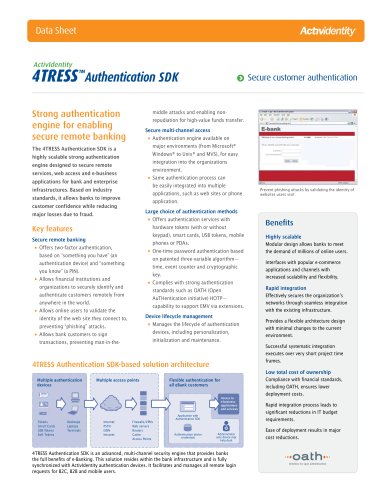
4TRESS Authentication SDK-based solution architecture
Multiple authentication devices
Multiple access points
Flexible authentication for all eBank customers
Access to e-business applications
and services
Application with Authentication SDK
Tokens Smart Cards USB Tokens Soft Tokens
Desktops
Laptops
Terminals
Firewalls/VPNs Web servers Routers Cache
Access Points
Internet PSTN ISDN Intranet
Administrator user device mgr help desk
Authentication device credentials
4TRESS Authentication SDK is an advanced, multi-channel security engine that provides banks the full benefits of e-Banking. This solution resides within the bank infrastructure and is fully synchronized with Activldentity authentication devices. It facilitates and manages all remote login requests for B2C, B2B and mobile users.
•■•oath»-
initiative for open authentication
DirectIndustry's Virtual Technical Library: PDF Catalogue | Technical Documentation | Brochure | Manual | Industrial directory | Specifications | Characteristics
Search Go
page 1 p.1
page 2 p.2
pdf-page pdf di En 2009-11-48-27